
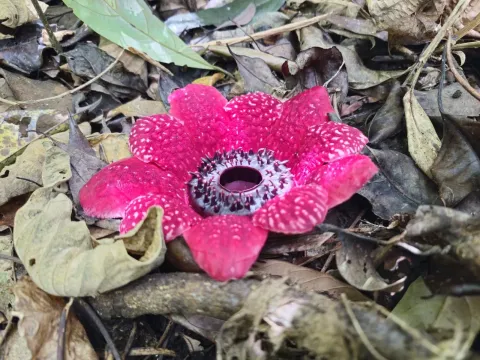
Sapria
Sapria
Sapria is a genus of extremely rare parasitic plants belonging to the Rafflesiaceae family. It is important to note that Sapria is not an agricultural crop; it lacks roots, stems, and leaves capable of photosynthesis, existing entirely as an obligate parasite.
What the section contains

Sapria
The natural distribution of Sapria is confined to the dense tropical rainforests of Southeast Asia, including parts of India, Thailand, and Vietnam. It requires a specific microclimate characterized by high humidity, constant temperature, and a rich layer of organic forest floor.
The plant spends most of its life cycle as a network of thread-like tissues inside the host plant, typically lianas of the genus Tetrastigma. It extracts water and essential nutrients directly from the vascular system of the host vine.
Because of its unique reliance on a living host and its complex life cycle, Sapria cannot be cultivated for human use. Agricultural techniques applicable to standard crops have no relevance to the biological needs of this parasitic organism.
Maintaining the survival of Sapria requires the preservation of its habitat. It cannot adapt to cultivated environments, as it depends on the presence of stable, undisturbed forest ecosystems and specific host plants.
The primary threat to Sapria is habitat destruction caused by large-scale deforestation in Southeast Asia. As the host vines are cleared to make way for plantations or urban development, the populations of Sapria vanish along with them.
Climate change poses a significant risk to the plant by altering the humidity levels of the rainforest floor. Excessive drying of the substrate can kill the endophytic parts of the plant before they even have a chance to bloom.
There are no known agricultural pests or diseases that target Sapria in the conventional sense. Instead, its survival is threatened by the degradation of the overall ecosystem health and the disappearance of the host species.
Over-collection by enthusiasts and habitat disturbance by invasive plant species or illegal logging operations further reduce the chances of natural pollination and seed dispersal.
Conservation efforts remain the only way to safeguard this botanical rarity. Unlike agricultural crops that are protected by pesticides or fertilizers, Sapria relies solely on the protection of its intact wilderness territory.