
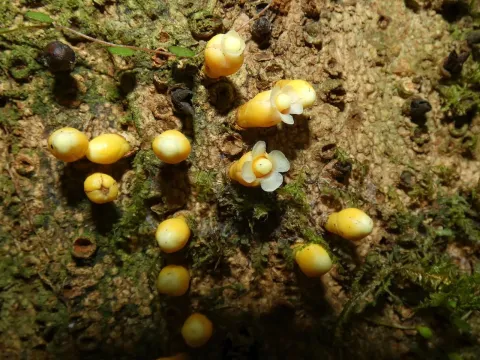
Apodanthes
Apodanthes
Apodanthes is a genus of endoparasitic plants belonging to the family Rafflesiaceae. Unlike conventional crops, it lacks vegetative organs such as leaves, stems, or true roots, existing primarily as a network of filaments within its host.
What the section contains

Apodanthes
The plant functions as an obligate parasite, living entirely within the tissues of woody host plants, particularly within the Salicaceae and Flacourtiaceae families. It extracts nutrients and water from the host's vascular system to sustain its metabolic functions.
The distribution of Apodanthes is largely concentrated in tropical regions of the Americas. It thrives in humid forest environments where it can successfully locate and colonize suitable host species through specialized biological interactions.
Because of its parasitic nature, this plant has no requirements for soil, fertilization, or standard irrigation techniques used in agriculture. It does not possess the mechanisms to grow independently of a host organism, making it unsuitable for commercial cultivation.
The study of Apodanthes is strictly confined to botanical and ecological research. Scientists focus on understanding its evolution and the complex chemical signaling that allows it to penetrate and integrate into the host's cellular structure without causing immediate destruction.