
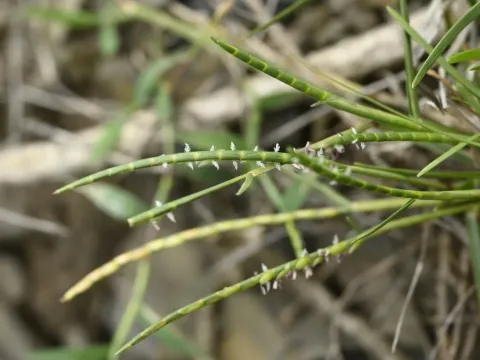
Mnesithea
Mnesithea
Sowing Mnesithea typically coincides with the beginning of the rainy season, ensuring adequate soil moisture for successful germination. In agricultural settings, ensuring a soil temperature consistently above 18-20 degrees Celsius is essential for uniform emergence.
What the section contains

Mnesithea
The seeds should be sown in rows, typically spaced 20–30 cm apart, to allow for optimal development. It is crucial to maintain shallow sowing depth, as the small size of the seeds limits their energy reserves to emerge from deeper soil layers.
Seeding rates depend on the intended use, such as pasture establishment or hay production. Utilizing precision drills can help distribute seeds evenly and ensure proper soil-to-seed contact, which is vital for quick establishment.
Post-sowing rolling is recommended to compact the soil slightly, facilitating capillary water movement to the seeds. This step is particularly important in drier environments where moisture retention near the soil surface is minimal.
During the first few weeks of growth, monitoring for weed competition is necessary, as young seedlings are vulnerable. Once the root system is established, the grass typically exhibits a vigorous growth habit, eventually forming a dense stand.
Mnesithea is a member of the Poaceae family, widely found in tropical and subtropical regions of Asia and Australia. It is a perennial grass species that has adapted to thrive in warm climates with high sunlight exposure.
The crop prefers well-drained loamy or sandy loam soils. While it possesses a degree of tolerance to periodic waterlogging, it performs best when the soil structure promotes good aeration and prevents long-term anaerobic conditions.
The species is highly heat-tolerant, making it an excellent candidate for cultivation in regions with high solar radiation. However, it is sensitive to freezing temperatures, which restricts its range to frost-free environments or summer-dominant seasons.
For optimal physiological activity, the soil pH should ideally be in the slightly acidic to neutral range. Alkaline or highly acidic conditions can cause nutrient deficiencies, manifesting as stunted growth or foliage discoloration.
While the plant can withstand short drought spells due to a robust root system, supplemental irrigation is beneficial for maximizing biomass production. Consistently moist, but not saturated, soil is the ideal balance for Mnesithea.
Yield potential of Mnesithea is significantly influenced by soil fertility levels and the availability of nitrogen. Balanced fertilizer application, particularly during active vegetative growth, can drastically increase dry matter production.
The plant shows high regrowth capacity, allowing for multiple harvests or intensive grazing cycles throughout the season. Proper management of grazing intervals ensures that the plant does not exhaust its root energy reserves.
Nutritional value peaks during the late vegetative stage, just before the onset of flowering. Harvesting at this time ensures a superior balance of proteins and fibers, which is essential for livestock dietary requirements.
To sustain long-term yield, it is critical to implement rotational grazing or periodic rest intervals for the pastures. Avoiding overgrazing helps maintain the vigor of the stand and prevents the encroachment of invasive weeds.
Data suggests that with appropriate management, Mnesithea can provide high annual yields of forage. It is increasingly recognized as a reliable component in tropical pasture systems where traditional grasses may fail.
Fungal diseases, such as rust and various leaf spot pathogens, represent the primary threat to Mnesithea stands, especially in high-humidity environments. These pathogens can significantly reduce photosynthetic leaf area if left unmanaged.
Common agricultural pests, including stem borers and sap-sucking insects, may occasionally infest the crop. These pests cause physical damage and may introduce secondary viral infections that weaken the plant stand.
Integrated pest management strategies are recommended, focusing on maintaining field hygiene and appropriate stand density. Avoiding over-fertilization with nitrogen can also prevent the overly succulent growth that often attracts pests.
Weed control is most critical during the crop's establishment phase. Implementing mechanical inter-row cultivation or using selective herbicides can help suppress competing species until the grass forms a full cover.
Regular field scouting is essential for early detection of any health issues. Proactive management and adherence to crop rotation principles are the most effective ways to mitigate the impact of biological threats.
For high-quality hay or silage, harvesting should occur before the plant reaches the heading stage. This timing preserves the highest nutrient content, as the plant tissue becomes increasingly lignified as it matures.
When harvesting for green fodder, the schedule should be adjusted to maximize biomass availability without compromising the plant's ability to regenerate. Careful timing ensures a continuous supply of fresh feed for livestock.
The cutting height should be set to at least 5–7 cm above the ground. This height is essential to prevent damage to the basal growing points, which are responsible for the plant's regrowth and overall stand longevity.
Seed harvesting requires precision to prevent yield loss due to shattering as the seeds ripen. Threshing should occur when the inflorescences show signs of maturity, typically indicated by a change in color to a straw-like hue.
Post-harvest handling of seeds includes cleaning and drying to reach a moisture content of 12–14%. Proper storage in cool, dry conditions is necessary to maintain high seed viability for subsequent planting seasons.