
Chinese Aeginetia
Aeginetia sinensis
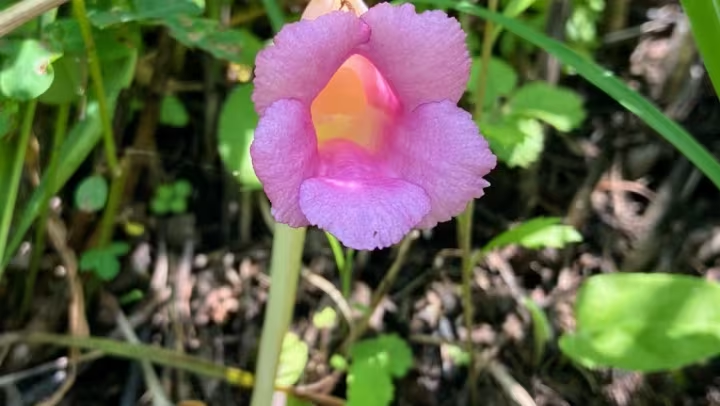
Description
Growing requirements
Chinese Aeginetia (Aeginetia sinensis) is a unique species belonging to the Orobanchaceae family. Unlike conventional crops, it is a holoparasitic plant, meaning it completely lacks chlorophyll and depends entirely on a host plant for nutrients, water, and carbohydrates.
The native range of this species is primarily concentrated in East Asia, with China being its main distribution center. It grows in habitats that support its specific host species, typically appearing in shady, humid forest environments where it attaches to subterranean roots.
Botanically, Aeginetia sinensis is characterized by a shortened stem with scale-like leaves and a prominent, often colorful flower. The vegetative parts remain mostly underground, and the root system is replaced by specialized structures known as haustoria, which penetrate the host's vascular tissues.
The plant requires specific environmental conditions to thrive, favoring high humidity and well-structured forest soils. It cannot be cultivated in standard agricultural fields because it requires a compatible living host to complete its complex lifecycle from germination to flowering.
While the plant has historical significance in traditional Asian herbal medicine, it is not grown as an agricultural crop. It serves primarily as an object of botanical and ecological study, highlighting the complex evolutionary adaptations of parasitic flora in forest ecosystems.