
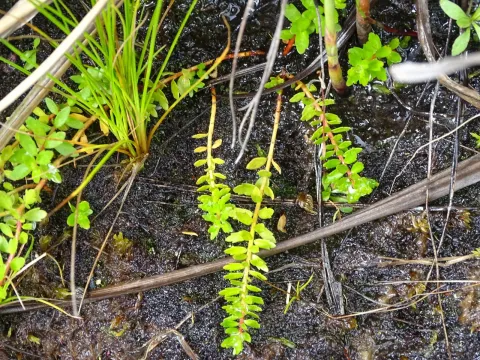
Laurembergia
Laurembergia
Laurembergia is a genus of herbaceous plants belonging to the Haloragaceae family. These plants are primarily characterized by their adaptation to aquatic and semi-aquatic habitats, often thriving in wet, swampy, or shoreline environments.
What the section contains


Laurembergia
The genus has a pantropical distribution, naturally occurring across diverse regions including Africa, Madagascar, Southeast Asia, and the Americas. Due to their specific environmental needs, they are often used as indicators of hydrological conditions in their native ecosystems.
Botanically, Laurembergia species typically feature creeping stems that root at the nodes. The foliage is often simple, with leaves arranged in an opposite or whorled pattern, allowing the plant to maximize surface area for photosynthesis in shaded or humid environments.
To cultivate or maintain populations of Laurembergia, one must ensure high soil moisture levels. The plants are highly sensitive to drought and require a substrate that remains saturated, preferably rich in organic matter and nutrients to support their rapid growth.
The climate requirements for the genus involve warm temperatures typical of tropical zones. They do not possess cold-hardiness and are generally restricted to frost-free regions, requiring protection from any fluctuations in temperature that could damage the vegetative mass.