
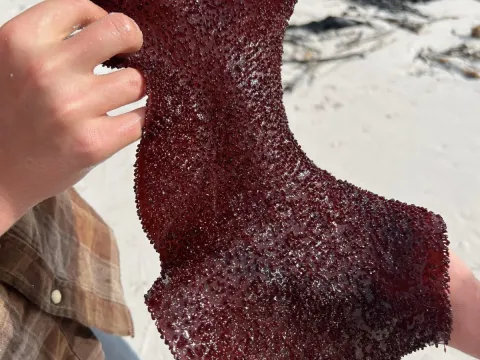
Gigartina
Gigartina
Gigartina is a perennial marine organism, so traditional seed sowing is not practiced; instead, farmers use vegetative propagation via thallus fragmentation.
What the section contains


Gigartina
The process begins by selecting healthy, mature specimens that are cut into precise pieces to serve as planting material for the next production cycle.
These fragments are attached to specialized ropes or mesh structures, which are then submerged into the ocean to provide a stable growth surface.
The timing of the planting phase is determined by seasonal water temperature fluctuations and the availability of natural light, typically starting in spring.
Effective nursery management ensures that these fragments are acclimated to the local water conditions before being transferred to open-sea plantations.
Gigartina belongs to the Gigartinaceae family and thrives in temperate coastal waters where there is consistent water movement and nutrient supply.
Light intensity is a critical requirement for photosynthesis, necessitating careful positioning of the growth ropes within the optimal depth range.
The water temperature must remain within a stable range, as sudden warming can inhibit metabolic processes and degrade the quality of the harvested seaweed.
Salinity levels must be maintained close to open-sea standards, as significant fluctuations or freshwater runoff can harm the plant's cell structure.
The support systems must be built using durable, non-corrosive, and marine-safe materials to withstand long-term exposure to salt water and currents.
Yield productivity for Gigartina is highly dependent on the current velocity and the nutrient concentration of the surrounding seawater at the farm site.
Commercial operations can achieve several tons of dry biomass per hectare when proper density management and site selection techniques are applied.
Productivity is further optimized by ensuring that individual strands are spaced widely enough to avoid shading and nutrient competition among the plants.
Strategic monitoring of biomass growth allows managers to predict the optimal harvest time, maximizing the extraction potential of industrial hydrocolloids.
Innovations in offshore cultivation, such as nutrient enrichment systems, have shown promising results in increasing the overall yield of high-quality crops.
Common threats to Gigartina include the growth of epiphytic algae and microorganisms that compete for limited sunlight and vital nutrients in the water column.
Climate change poses a significant long-term risk, as ocean warming alters the natural habitat and can trigger stress-related diseases in seaweed crops.
Herbivores and various marine invertebrates can cause physical damage to the thalli, which in turn can lead to secondary infections and tissue decay.
Regular maintenance, including cleaning the ropes from biofouling and inspecting the crops, is essential to prevent large-scale infection outbreaks.
Extreme storm events represent a major environmental challenge, as high-energy waves can destroy infrastructure and result in significant crop loss.
Harvesting is performed when the seaweed reaches its peak physiological maturity, which is the point of maximum concentration of valuable carrageenan.
Farmers use careful cutting techniques that leave the base of the thallus intact, enabling the plant to regenerate for subsequent harvest cycles.
Once harvested, the seaweed must be thoroughly washed to remove sand, shell fragments, and excess salt before proceeding to the drying phase.
Drying is a critical quality control step, usually conducted in solar dryers or climate-controlled facilities to preserve the complex chemical structure.
The finished, dried product is packaged and transported to processing plants to be refined into stabilizers, thickeners, and various industrial ingredients.