
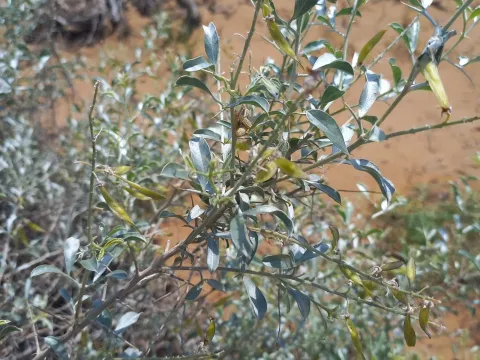
Sand acacia
Ammodendron
Sowing of sand acacia seeds for industrial purposes is typically performed in late autumn or early spring. Autumn sowing is considered optimal because it allows seeds to undergo natural stratification in the soil, which significantly improves germination rates in the spring.
What the section contains

Sand acacia
When sowing in the spring, it is crucial to ensure sufficient moisture in the topsoil, so planting must occur immediately after the ground thaws. Planting depth generally ranges from 2 to 4 centimeters, depending on the sandy soil texture.
For better establishment, seeds are often cleaned from their pericarps before sowing. In regions prone to spring droughts, the soil surface is usually rolled after sowing to preserve capillary moisture around the seeds.
Planting density is determined by the specific land reclamation goals. Denser patterns are utilized to stabilize shifting dunes quickly, creating a robust barrier against wind erosion.
Young seedlings are extremely vulnerable to moisture stress and high solar radiation during their first weeks, making the precise timing of sowing essential for successful establishment in desert environments.
The sand acacia is a classic psammophyte, perfectly adapted to the harsh conditions of sandy deserts and semi-deserts. The species exhibits remarkable resistance to extreme temperature fluctuations and atmospheric drought.
The plant prefers loose, sandy soils with deep groundwater levels, though its powerful root system can reach water tables at significant depths. It does not tolerate waterlogging or dense clay horizons that impede root aeration.
Abundant light is mandatory for normal growth; shading at any development stage leads to severe suppression and plant death. Sand acacia easily survives the strong winds characteristic of open dune landscapes.
In its natural habitat, the plant has adapted to soils with very low humus content. However, applying minimal phosphorus and potassium fertilizers during planting on degraded sites can significantly boost the growth of young plants.
This species is a vital tool for forest reclamation, helping stabilize moving sands, prevent erosion, and create a favorable microclimate for other desert-adapted flora.
The biological productivity of sand acacia is not measured in traditional crop yields but rather by the volume of biomass produced for phytoremediation. Annual growth is heavily dependent on precipitation and the age of the plant.
In favorable years, mature plants generate significant wood and shoot volume, acting as a crucial source of organic matter in desert conditions. Usage as forage is limited due to the specific chemical composition of its leaves.
Survival rates for plantation efforts typically range from 30% to 70%, depending on site preparation and initial care. Peak biomass accumulation is usually observed in plants between 5 and 15 years old.
Economic use includes emergency fodder harvesting for camel farming, though excessive exploitation is discouraged to avoid destroying the essential ground cover that prevents sand shifting.
The success of the culture is ultimately measured by the total area of stabilized sands, where sand acacia serves as the primary ecosystem engineer.
Sand acacia is highly resistant to most diseases due to its evolutionary adaptation to harsh desert environments. However, in artificial plantations, it may be subject to attacks by specific pests.
Grasshoppers and locusts pose the greatest danger, as they can completely strip foliage and young shoots, weakening the plants. Additionally, larvae of certain weevil species can damage the root collar and stems.
Fungal infections are rare and usually associated with abnormally humid periods, which can lead to root rot. Powdery mildew or rust may only appear in overly dense, poorly aerated stands.
Rodents, such as gerbils, can cause damage by gnawing on the bark and buds of young plants, significantly slowing growth and occasionally causing seedling mortality during dry seasons.
Pest control in large-scale plantations is rarely practiced due to ecological constraints; the primary defense strategy is to maintain plant vigor through correct site selection and proper agricultural practices.
Harvesting, in the traditional agricultural sense, is not performed for sand acacia due to its primary role in environmental protection. However, intentional seed collection is conducted for propagation purposes.
Seeds are harvested in late summer or early autumn. It is important to collect the pods before they naturally crack open to prevent losses of the seed stock.
After collection, seeds are cleaned, dried, and stored in cool, dry facilities. When handled correctly, seeds maintain high germination viability for several seasons.
In forestry practice, sanitary pruning of dry branches is occasionally carried out to manage stand health, but this is not considered a bulk harvest.
All operations must be planned to preserve the root system and avoid destabilizing the sands that the plantations are intended to protect.