
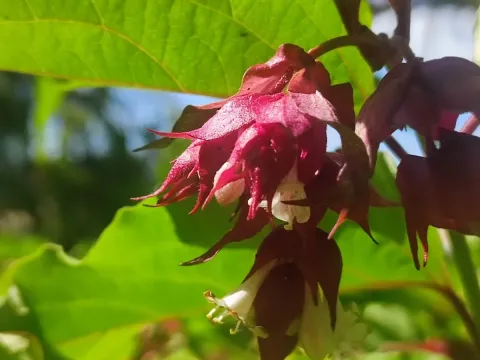
Leycesteria
Leycesteria Wall.
Leycesteria is a distinctive deciduous shrub belonging to the Caprifoliaceae family. Native to the mountainous regions of the Himalayas and Southwestern China, this plant is well-adapted to cool, temperate climates and thrives in high-altitude environments.
What the section contains

Leycesteria
Botanically, Leycesteria is characterized by its hollow, cane-like stems and opposite, ovate leaves. The plant is most notable for its pendulous, raceme-like inflorescences, which are enclosed by prominent, colorful bracts that add significant visual interest to any garden setting.
The cultivation requirements focus on providing a site with well-draining, humus-rich soil that remains consistently moist. Ideally, Leycesteria should be planted in a sunny location that offers some protection from cold, drying winds, especially during the early spring growth phase.
Proper agronomic care involves moderate irrigation and the application of mulch to conserve soil moisture. Pruning should be carried out annually, ideally in late winter or early spring, to remove dead wood and encourage the vigorous growth of new flowering stems.
In terms of хозяйственное usage, Leycesteria is valued primarily for its ornamental qualities in landscape design. It is frequently used in shrub borders or as a specimen plant, providing a unique architectural element to gardens during the late summer and autumn seasons.
While Leycesteria is generally robust, it may be susceptible to powdery mildew, especially if planted in poorly ventilated or excessively damp conditions. Good cultural practices, such as ensuring proper spacing between plants, are essential for preventing fungal outbreaks.
Insect pests including aphids and spider mites may occasionally infest the plant, particularly in dry conditions. Regular monitoring of the foliage and the application of appropriate horticultural soaps or systemic insecticides will effectively mitigate these threats and ensure plant health.