
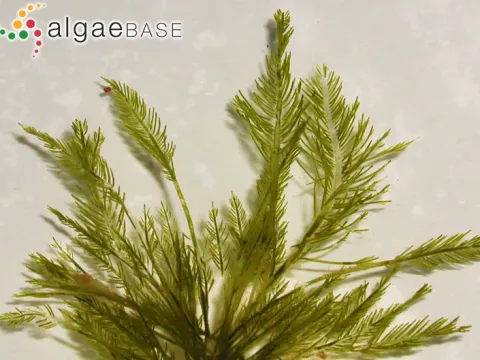
Bryopsis
Bryopsis
Bryopsis is a genus of siphonous green algae belonging to the family Bryopsidaceae. These organisms are scientifically notable for their unique cellular architecture, as the entire thallus consists of a single, highly branched, multinucleate cell.
What the section contains


Bryopsis
The genus has a worldwide distribution, primarily inhabiting shallow marine environments in both tropical and temperate regions. They typically attach to rocky substrates where they can access adequate sunlight for photosynthesis and consistent water flow.
Regarding environmental requirements, Bryopsis thrives in water rich in nitrogen and phosphorus compounds. They are highly efficient at nutrient uptake, which allows them to colonize areas rapidly, sometimes becoming dominant in specific marine niches or aquarium environments.
The growth and structural integrity of this alga depend heavily on light intensity and salinity stability. As a siphonous organism, it lacks cross-walls within its filaments, allowing for the rapid translocation of cytoplasm and nutrients throughout the structure.
In terms of practical utility, Bryopsis is not a standard agricultural crop. Instead, it serves as a critical model organism for phycological and cellular research, particularly in studies concerning morphogenesis, cytoplasmic streaming, and the evolution of multicellular-like structures in unicellular organisms.
The primary biological threat to Bryopsis populations is grazing by specialized marine herbivores, such as certain species of sacoglossan sea slugs. Despite their feeding activity, the algae possess chemical defense mechanisms that deter many common reef fish.
Management of this alga is notoriously difficult due to its high regenerative capacity. Even microscopic fragments of the thallus are capable of regenerating a complete new colony, making traditional eradication methods largely ineffective in controlled aquatic environments.