
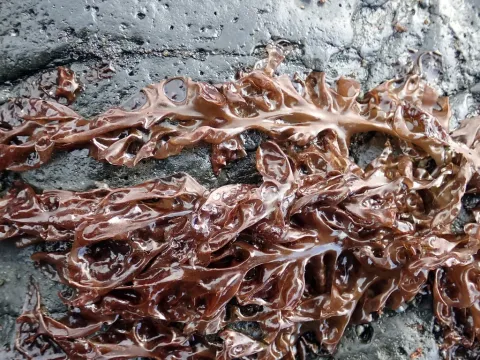
Pyropia
Pyropia
The cultivation cycle of Pyropia begins with the artificial seeding of substrates with spores (conchospores). On an industrial scale, this process is conducted in specialized hatcheries where temperature and light conditions are strictly regulated.
What the section contains
 Pyropia tenera
 (Kjellman) N.Kikuchi, M.Miyata, M.S.Hwang & H.G.Choi
Pyropia tenera
Pyropia tenera (Kjellman) N.Kikuchi, M.Miyata, M.S.Hwang & H.G.Choi
 Pyropia yezoensis
 (Ueda) M.S.Hwang & H.G.Choi
Pyropia yezoensis
Pyropia yezoensis (Ueda) M.S.Hwang & H.G.Choi
Pyropia
Once the spores have settled on net collectors, they are deployed in open sea environments. The optimal time for setting the nets is early autumn, when water temperatures reach the ideal range for growth.
Thallus development occurs in dynamic ocean current conditions, which ensure a constant supply of nutrients. It is crucial to manage net density to prevent sunlight deficiency for the lower layers of the plants.
Throughout the growing season, farmers perform regular inspections of the thallus condition. Monitoring allows for timely adjustments in the depth of the collectors to optimize photosynthetic activity.
The maturation of harvestable biomass occurs several months after the start of the season. The readiness of the crop is determined by the characteristic deep color and the size of the leafy blades.
Pyropia belongs to the family Bangiaceae and is a representative species of red macroalgae. For successful development, the crop requires high water transparency and moderate salinity levels.
A key factor for growth is the presence of nitrogenous compounds and phosphates in the water, which act as natural fertilizers. The temperature range for growth is between 5 and 15 degrees Celsius.
The culture is highly sensitive to changes in salinity caused by heavy rainfall or river runoff. Therefore, farms are typically situated in bays with efficient water exchange systems.
Synthetic nets stretched between supporting structures are used for thallus attachment. This setup allows the seaweed to efficiently utilize the energy of tidal currents.
Light intensity plays a decisive role in pigment composition and the chemical profile of the algae. In regions with shorter daylight hours, methods to increase water transparency near farms are applied.
The yield of Pyropia depends directly on the quality of the seed stock and local hydrological conditions. On average, three to five full harvest cycles can be completed within a single season.
Modern intensive technologies enable the production of up to 10–15 tons of dry product per hectare annually. Stability is ensured by breeding strains resistant to sudden temperature fluctuations.
A significant portion of the harvest is utilized by the food industry to produce nori, the pressed sheets of dried seaweed. Product quality is determined by protein and amino acid content.
After harvesting, the raw material undergoes primary processing, including washing, shredding, and molding. Adherence to drying technology ensures the preservation of essential minerals and vitamins.
Economic efficiency depends on logistics and the proximity of processing facilities to the harvest sites. While fresh product is highly valued, dried seaweed remains the primary export commodity.
The main threats to Pyropia are pathogenic fungi and bacteria that infect the thallus during temperature anomalies. Such infections often lead to blade bleaching and subsequent tissue decay.
Pests, such as small crustaceans, can damage the algae tissue, reducing both aesthetic appeal and total yield. Environmentally safe water management techniques are used to control these pests.
Pollution of marine areas with heavy metals and toxins poses a serious risk to crop safety. Regular laboratory monitoring of water quality and plant tissues is essential.
Epiphytic algae that colonize the nets compete for nutrients. To prevent overgrowth, farmers regularly clean the collectors of unwanted flora.
Climate change and rising ocean temperatures are forcing operations to shift to higher latitudes. Global warming remains the most significant long-term challenge for the industry.
Harvesting is performed mechanically using specialized harvester vessels. The cutting apparatus trims the thalli while leaving the base intact to allow for subsequent regrowth of biomass.
The timing of the harvest is chosen based on tidal cycles, when biomass concentration on the nets reaches its peak. Harvesting during early morning hours is generally considered optimal.
Immediately after removal from the water, the seaweed is transported to the processing plant to prevent spoilage. Raw material quality deteriorates rapidly if the cold chain is breached.
During harvesting, it is critical to avoid mechanical damage to the root system (rhizoids) to ensure a high regeneration rate. A clean cut guarantees a stable follow-up harvest.
All harvested product is sorted based on blade size and pigment content. After sorting, the raw material is cleaned of impurities and prepared for the drying process.