
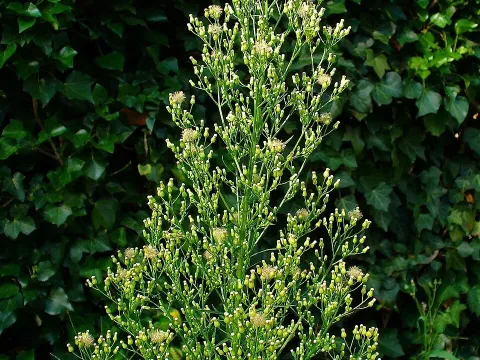
Horseweed
Conyzigeron
Horseweed, scientifically known as Conyza canadensis, belongs to the Asteraceae family. It is a highly adaptable plant, often recognized as a significant weed in various cropping systems throughout the temperate regions of the world.
What the section contains
Horseweed
The plant exhibits both winter annual and summer annual growth habits. Seeds are extremely small, light, and equipped with a pappus, allowing for long-distance dispersal via wind currents across agricultural landscapes.
Germination typically occurs when soil temperatures reach approximately 8 to 10 degrees Celsius. Seeds are shallow germinators, rarely emerging from depths greater than 0.5 centimeters, which makes them sensitive to soil surface disturbances.
Upon germination, the plant initially forms a basal rosette, which is highly resistant to cold weather. As spring approaches, the plant initiates vertical stem elongation, eventually producing multiple flowering branches.
The biological life cycle of horseweed is marked by prolific seed production. A single mature plant can produce hundreds of thousands of seeds, ensuring its persistence in the seed bank for multiple seasons.
Horseweed thrives in diverse soil types, ranging from sandy loams to heavier clay soils. It does not possess strict nutrient requirements, allowing it to colonize disturbed areas where other plants might struggle to establish.
The species is notable for its excellent drought tolerance. Its deep taproot enables the plant to access moisture from lower soil profiles, providing a competitive advantage over many shallow-rooted crop species during dry spells.
Light availability is a critical factor for horseweed development. It is an obligate heliophyte, meaning it requires full sunlight to achieve maximum growth potential and reach its full height of over one meter.
Regarding climate, horseweed is exceptionally hardy. It tolerates significant temperature fluctuations and can survive in a variety of climatic zones, from temperate to semi-arid, reflecting its broad ecological range.
Agronomic management requires consistent efforts to maintain soil cover. Strategies such as crop rotation, dense seeding rates, and the use of cover crops are effective in limiting the light availability required for horseweed to germinate and thrive.
While horseweed is relatively resistant to many common pests, it can be affected by various fungal pathogens under humid conditions. Powdery mildew is the most frequently observed infection, affecting leaf surface health.
Insects like aphids and various bugs may occasionally infest horseweed plants. However, the plant's chemical composition, including secondary metabolites, generally acts as a deterrent to most major herbivores.
The primary threat to horseweed populations in modern agriculture is the use of broad-spectrum herbicides. However, global reports have confirmed the development of glyphosate-resistant biotypes, necessitating integrated weed management.
Mechanical control methods remain highly effective. Tillage operations, including plowing and cultivation, disrupt the root system and bury seeds to depths where they are unable to successfully emerge.
- Integrated weed management programs.
- Pre-emergence herbicide applications.
- Mechanical cultivation during the rosette stage.
- Maintaining high crop competitiveness.