
Louise's swallow-wort
Cynanchum louiseae
Louise's swallow-wort (Cynanchum louiseae) is a perennial herbaceous vine belonging to the Apocynaceae family. It is recognized as a highly invasive plant species that poses a significant threat to agricultural productivity and natural biodiversity.
What the section contains
Louise's swallow-wort
Originally native to Europe, it has established itself as a problematic weed in North America. The species thrives in a variety of environments, ranging from open fields and pastures to roadsides and woodland margins, demonstrating high ecological adaptability.
The plant requires well-drained soils and shows a preference for limestone-derived substrates. It is particularly competitive in full sun, where its twining habit allows it to climb over other vegetation, effectively suppressing them by limiting light penetration.
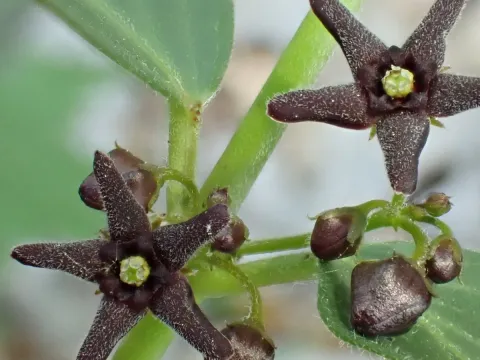
Botanically, it features opposite, heart-shaped leaves and clusters of small, star-shaped dark purple flowers. Its root system is deep and rhizomatous, allowing for vigorous regrowth if the plant is disturbed or cut without removing the underground biomass.
In agricultural settings, this species is considered a persistent weed rather than a crop. Its presence necessitates aggressive management strategies to prevent it from outcompeting forage crops and obstructing harvesting machinery during field operations.
Managing Louise's swallow-wort is challenging due to its resilient root system. Mechanical control, such as mowing or tillage, is only effective if performed repeatedly, as the plant can store significant energy reserves in its rhizomes.
Chemical control remains the most effective intervention. Systemic herbicides applied at the pre-flowering stage are crucial to ensure that the active ingredients translocate to the root system, thereby reducing the plant's ability to regenerate in subsequent seasons.
Biological control research is ongoing, with entomologists investigating the potential of host-specific insects to suppress populations. While promising in laboratory conditions, these agents have not yet become a staple of broad-acre weed management programs.
There are very few natural diseases that affect this plant in North America, which contributes to its invasive success. Without competition or natural predators, the plant density can increase rapidly, creating dense monocultures that are difficult to eradicate.
Integrated Pest Management (IPM) is the recommended approach for farmers. This involves a combination of monitoring, proper crop rotation, and the judicious use of herbicides to exhaust the seed bank and suppress the vegetative growth of this noxious weed.