
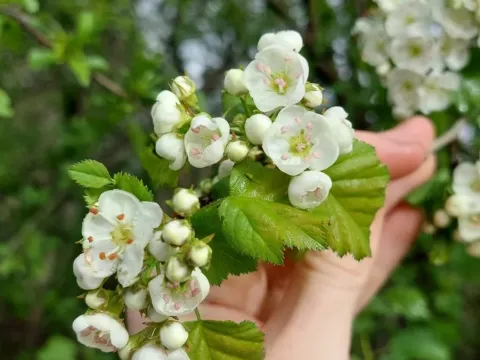
Scarlet hawthorn
Crataegus pedicellata
Scarlet hawthorn (Crataegus pedicellata) belongs to the Rosaceae family. The propagation of this culture is most often carried out by seeds, but the seeds have a deep dormancy and require long-term stratification.
What the section contains
Scarlet hawthorn
For sowing, seeds are stratified at temperatures between +1 and +5 degrees Celsius for 6–8 months to overcome embryonic dormancy. Sowing in open ground is carried out in late autumn or in the spring after preliminary seed preparation.
For vegetative propagation, root suckers or grafting onto more resistant rootstocks are used, which allows for obtaining a fruit-bearing plant faster.
Planting saplings in their permanent location is best done in autumn or early spring, before sap flow begins. The distance between plants should be at least 2–3 meters to ensure normal crown illumination.
Young plants require regular watering and weeding of the tree trunk circle in the first years of life, which contributes to rapid rooting and the development of a powerful root system.
Scarlet hawthorn is a frost-resistant and drought-tolerant crop originating from North America. It adapts well to temperate climate conditions and withstands severe winter temperature drops.
For full development, the plant requires a sufficient amount of sunlight, as yields significantly decrease in the shade and the decorative properties of the bush deteriorate.
The culture is not very demanding in terms of soil conditions, but it develops best on fertile, well-drained loams with a neutral or slightly alkaline reaction.
An important requirement is the absence of stagnant moisture in the root system, which can lead to root rot. When planting on heavy clay soils, it is recommended to install a drainage layer.
Care for the culture includes periodic sanitary pruning aimed at removing dry and damaged branches, as well as thinning the crown to improve aeration.
The yield of scarlet hawthorn depends on the age of the plant, lighting conditions, and the general level of agricultural practices. Fruiting usually begins at 6–8 years after planting.
The fruits are bright red apple-like drupes reaching up to 1.5–2 centimeters in diameter. They are collected in dense corymbose inflorescences, which facilitates the harvesting process.
From one adult bush, with proper care, you can harvest 5 to 10 kilograms of fruit. High yields are achieved with regular application of organic and mineral fertilizers.
In commercial horticulture, the crop is used for processing: making jam, preserves, compotes, and drying raw materials for the pharmaceutical industry.
A stable yield also depends on the presence of pollinating insects, as hawthorn is an entomophilous plant that needs cross-pollination to form full-fledged fruits.
Scarlet hawthorn is susceptible to attack by specific pests, among which the hawthorn aphid, codling moth, and leaf rollers represent a particular danger.
Among diseases, leaf rust and powdery mildew are the most common, which can significantly weaken the plant and reduce its productivity in unfavorable years.
- Rust: manifests as orange spots on leaves, requiring fungicide treatment.
- Powdery mildew: forms a white coating on young shoots and fruits.
- Codling moth: reduces fruit quality by damaging the pulp and seeds.
For prevention, it is recommended to carry out timely sanitary pruning and destruction of fallen leaves, where fungal pathogens can overwinter.
In case of mass pest outbreaks, comprehensive insecticide preparations are used, strictly observing waiting periods before harvest to ensure product safety.
Harvesting of hawthorn fruits begins in the phase of full biological maturity, when the skin acquires a characteristic rich bright red color and the fruits become moderately soft.
Optimal harvest times fall in late September or early October, depending on the climatic characteristics of the growing region.
Harvesting is carried out manually or by carefully cutting the fruit stalks with pruning shears, trying not to damage the plant's shoots. Mechanical harvesting is difficult on this crop due to the presence of sharp thorns on the branches.
After harvesting, the fruits must be immediately delivered to the processing site or dried in well-ventilated rooms at a temperature not exceeding 40 degrees Celsius.
Properly harvested and dried fruits retain their healing properties for several years, which allows for effective use of the raw materials in phytotherapy and the food industry.