
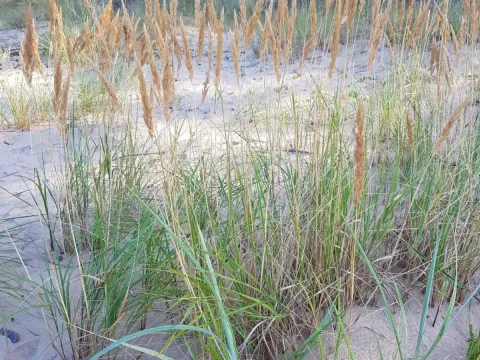
Baltic marram grass
Ammocalamagrostis baltica
Baltic marram grass is a perennial hybrid belonging to the Poaceae family. It is a natural crossbreed known for its robust growth habit and ability to thrive in challenging sandy environments.
What the section contains
Baltic marram grass
This grass is highly valued for its long, creeping rhizomes, which form an extensive underground network. This network acts as a structural anchor, binding loose sand particles and stabilizing dune systems against wind erosion.
The species is perfectly adapted to coastal climates, showing high tolerance to salinity, drought, and high-intensity ultraviolet radiation. It requires well-drained, sandy soils and full sun to establish its dense vegetation cover.
Cultivation practices primarily focus on site preparation in coastal areas. Strategic planting of rhizome cuttings during the dormant season provides the best establishment results in shifting sand environments.
Beyond its ecological role in landscape stabilization, it serves as a keystone species for coastal biodiversity. Its dense clusters provide habitats for various coastal organisms and protect the ecosystem from sea-level rise impacts.
Baltic marram grass is exceptionally hardy and exhibits strong natural resistance to traditional agricultural pests such as aphids or stem borers due to its high silica content.
The most significant threat to the survival of this grass is human activity, specifically recreational foot traffic and vehicular movement across sand dunes, which damages the delicate shoots and rhizome mats.
Invasive plant species can occasionally outcompete the grass if the dune becomes excessively nutrient-rich, though the grass generally maintains dominance in its preferred nutrient-poor habitat.
While fungal pathogens can theoretically affect the plant in waterlogged conditions, such environments are rarely found in its natural range, making chemical disease management largely unnecessary.
Overall, the plant is robust and requires no standard pesticide programs, making it an ideal choice for low-maintenance environmental restoration projects in maritime regions.