
Mountain tulip
Tulipa montana
Description
Growing requirements
The mountain tulip (Tulipa montana) belongs to the Liliaceae family and is recognized for its compact size and resilience in high-altitude environments. Its native range spans across the mountainous regions of Iran, Turkmenistan, and surrounding areas, where it thrives on rocky slopes.
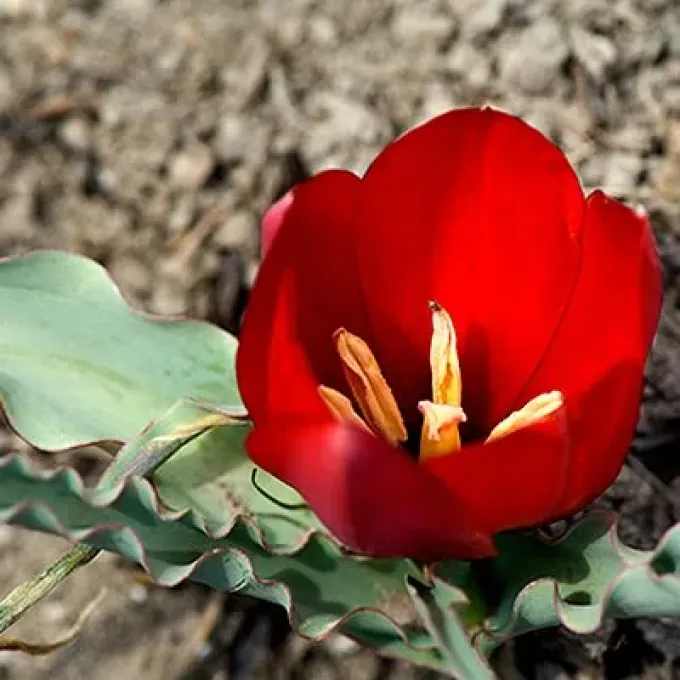
Botanically, it is a bulbous perennial featuring a small, tunicated bulb and glaucous, slightly wavy leaves. Its height typically ranges between 10 and 20 cm, making it a perfect candidate for alpine gardening where taller varieties might look out of proportion.
The flower is distinct, characterized by deep red petals with a dark, almost black basal blotch, often outlined in yellow. This species blooms early in the spring, signaling the transition of seasons in its harsh, mountainous natural habitat.
Cultivating Tulipa montana requires mimicking its natural environment: bright, direct sunlight and exceptional drainage. In garden settings, these tulips are best suited for rockeries, scree gardens, or containers where moisture control can be strictly managed.
The soil must be gritty, sandy, or stony with a neutral to slightly alkaline pH. Organic-rich or heavy clay soils are detrimental to the plant, as they hold too much moisture, leading to the rapid decay of the bulb during its dormancy phase in the summer.
Main diseases and pests
The most significant threat to the mountain tulip is fungal infection, particularly Fusarium and other bulb rots caused by poor drainage or excessive soil moisture. Preventive measures include using sterile growing media and applying systemic fungicides before planting.
Common pests include bulb mites, which attack the base of the bulb, and occasionally aphids that target the developing leaves. Regular inspection and localized treatment are necessary to ensure the health of the collection, especially in climates that are wetter than the plant's natural range.