
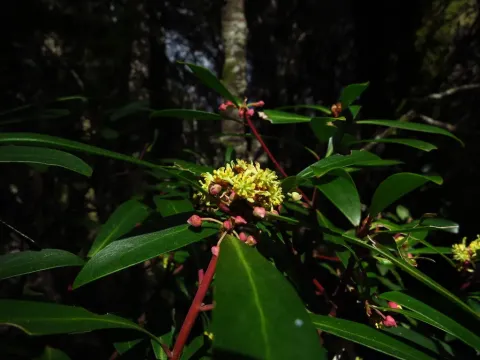
Tasmannia
Tasmannia
Tasmannia belongs to the Winteraceae family and consists of evergreen shrubs or small trees. These plants are native to the moist, temperate, and sub-alpine forests of Australia, particularly Tasmania, where they thrive in rich, cool environments.
What the section contains


Tasmannia
The cultivation of Tasmannia requires specific environmental conditions. They prefer sites with partial shade, protecting the foliage from intense direct sunlight, which can lead to leaf burn and reduced plant vigor.
Soil conditions are critical for healthy growth. The plants require acidic, well-draining soil that is rich in organic matter. They perform best in soils with a pH ranging between 5.0 and 6.5, mimicking their natural forest-floor habitat.
Adequate moisture is essential, but the plant is highly sensitive to waterlogging. Implementing a drip irrigation system is recommended to ensure a consistent soil moisture level without saturating the root zone.
The climate should remain relatively mild. While some species are hardy to light frosts, they generally perform best in areas where extreme temperature fluctuations are minimized throughout the growing season.
The primary economic use of Tasmannia is the production of the so-called "Tasmanian pepper." Both the dried berries and the leaves are harvested for their unique, pungent flavor, which is attributed to the presence of polygodial.
Commercial yields typically begin to stabilize 3 to 5 years after planting. Proper pruning is essential to maintain the structural integrity of the bushes and to encourage the development of new flowering branches.
Harvesting is performed manually once the fruits reach full maturity, indicated by a deep purple or black color. Immediate post-harvest processing, including controlled drying, is necessary to lock in the essential oils and aroma.
Leaves are also harvested throughout the year for their commercial value in the culinary and wellness industries. Selective harvesting ensures that the plant remains healthy and continues to produce high-quality foliage.
Successful management of the crop involves regular mulch application to preserve soil temperature and suppress weeds, which is crucial for maintaining the health and productivity of the shrub in commercial orchards.
Tasmannia is susceptible to a range of pests, with scale insects and spider mites being the most common in drier conditions. These pests can rapidly colonize the undersides of leaves, requiring early intervention.
Root rot, often caused by Phytophthora species, remains the most significant disease risk. It is predominantly associated with poor drainage and excessive watering, leading to systemic failure of the plant.
Fungal leaf spot diseases can occur during prolonged periods of high humidity and poor ventilation. Keeping the canopy open through strategic pruning is an effective way to mitigate this risk.
In humid forest-like plantations, bryophytes and lichens may grow on the bark. While they are usually harmless, their excessive growth can be a sign of a microclimate that is too wet for the long-term health of the wood.
Integrated Pest Management (IPM) is the preferred approach, focusing on biological controls and cultural practices such as spacing and sanitation to maintain a healthy plantation without heavy reliance on chemicals.