
Saxifraga longifolia
Saxifraga longifolia Lapeyr.
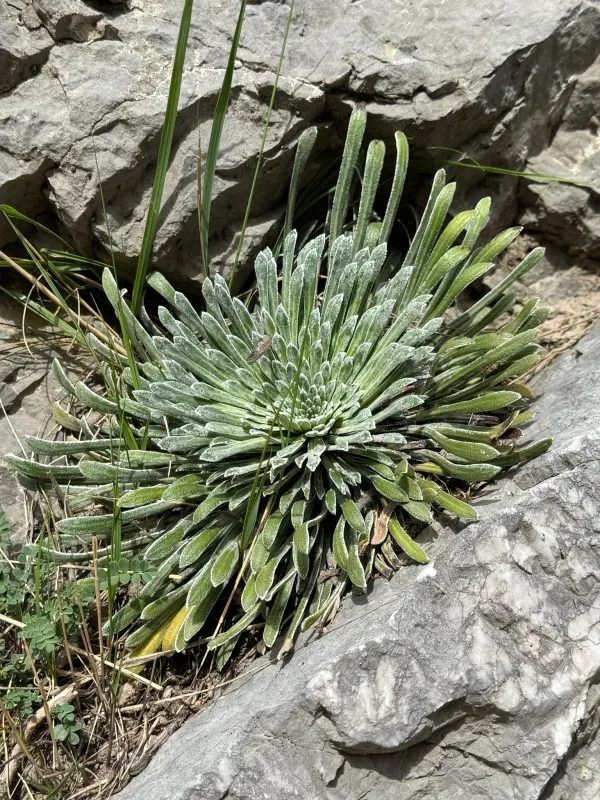
Description
Sowing dates
The sowing of Saxifraga longifolia should be carried out in late winter or early spring to allow for a necessary cold stratification period. Seeds are minute and must be sown on the surface of a moist, gritty medium without being buried.
For successful germination, place the seed trays in a cold environment (around 4°C) for several weeks. Afterward, move them to a brighter area with moderate temperatures to encourage the development of the primary rosette.
Pricking out the seedlings requires great care to avoid damaging their delicate root systems. It is best to use tweezers and transplant them into individual small pots containing a mix of sand, grit, and loam.
Transplanting into the garden should happen after the risk of frost has passed. Choose a site that replicates the plant's natural habitat, such as a vertical crevice in a rock garden or a wall facing north or east.
Vegetative propagation is also possible through offsets, which can be separated after flowering. These should be potted into a sharp, well-draining substrate until they establish a root system and can be planted out.
Growing requirements
Saxifraga longifolia, a member of the Saxifragaceae family, is a monocarpic perennial renowned for its large, symmetrical, lime-encrusted rosette. It is a true lithophyte, naturally occurring in the crevices of limestone cliffs.
The primary cultural requirement is perfect drainage. The plant will suffer and likely die if water is allowed to pool around the base of the rosette; therefore, slopes or vertical planting are strongly recommended.
It thrives in cool, alpine-like conditions. While it appreciates bright light, it is sensitive to intense, direct afternoon sun in warmer climates, which can scorch the foliage and cause excessive dehydration.
The soil should be mineral-based, porous, and neutral to slightly alkaline, containing plenty of limestone chippings. Regular fertilizing is generally not necessary, as the plant is adapted to nutrient-poor environments.
Water management is critical during the growing season. Use a narrow-spouted watering can to irrigate the soil, ensuring that the leaves of the rosette remain dry to prevent rot and mineral buildup.
Main diseases and pests
Fungal infections, specifically crown rot and Botrytis, are the most significant threats to the plant's survival. These are almost always caused by poor air circulation or excessive moisture settling in the center of the rosette.
Spider mites can occasionally infest the plants, particularly during periods of low humidity. Symptoms include a mottled appearance of the leaves and fine webbing, which requires immediate treatment with appropriate acaricides.
Aphids may target the long, impressive flower spikes that emerge from the center of the rosette during the blooming phase. If left untreated, they can weaken the plant and reduce seed production.
Slugs and snails represent a major danger, as they find the tender, succulent leaves of the rosette highly palatable. A perimeter of sharp grit or copper tape is effective in deterring these mollusks.
Maintaining a clean growing environment is the best prophylactic measure. Remove all debris around the base of the plant to prevent the accumulation of moisture and provide fewer hiding spots for pests.