
Liberian sansevieria
Sansevieria liberica
Description
Growing requirements
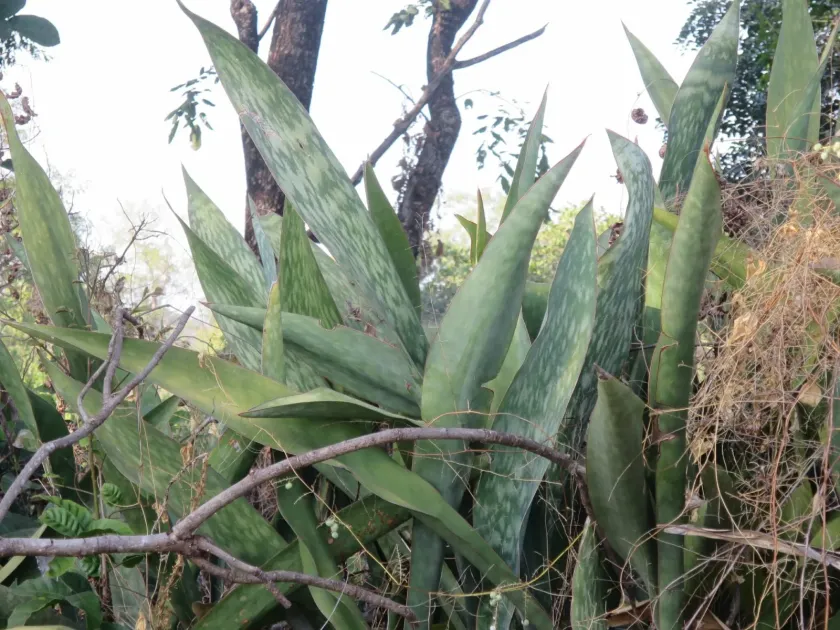
The Liberian sansevieria (Sansevieria liberica) is a robust perennial herb belonging to the Asparagaceae family. Originally native to tropical regions of West Africa, it thrives in environments characterized by warm temperatures and well-draining soil types.
Botanically, the plant is identified by its stiff, succulent, sword-like leaves that emerge directly from thick, creeping rhizomes. These leaves are highly adapted to arid conditions, serving as storage organs for water and nutrients, which allows the species to survive drought cycles.
Optimal cultivation requires steady tropical temperatures between 20°C and 30°C. The soil must be loose, sandy, or loamy, ensuring excellent drainage. Waterlogging is the primary threat to the crop, as it quickly induces rhizome rot and can destroy entire plantation segments.
Agricultural management involves careful light control; while the plant is resilient, bright indirect light promotes the best fiber development. Balanced fertilization, focusing on potassium rather than high nitrogen, is recommended to ensure leaf durability and fiber quality.
Field maintenance includes regular weeding to reduce nutrient competition. Propagation in commercial settings is almost exclusively vegetative, through rhizome division, as this method ensures genetic consistency and rapid establishment of new planting units.
Harvesting
Sansevieria liberica is primarily cultivated as a fiber crop. Its leaves contain long, strong, and flexible fibers that are historically significant for the production of high-tensile cords, ropes, and specialized industrial textiles.
Harvesting is performed by selectively cutting mature, fully developed leaves at the base. Growers often implement a multi-stage harvesting cycle, ensuring that enough photosynthetic tissue remains on the rhizome to support continuous new leaf production.
Post-harvest processing involves mechanical decortication, where the pulp is scraped away to isolate the long fibers. This step must be performed shortly after harvest to prevent chemical changes in the plant tissue that could compromise fiber tensile strength.
The yield is measured by the total mass of high-quality fiber per hectare. Sustainable management practices aim to maximize cellulose content by monitoring the plant's growth stage and adjusting irrigation during dry seasons without over-saturating the substrate.
Market demand for natural, biodegradable fibers has sparked renewed interest in such traditional crops. Research currently focuses on optimizing the mechanical extraction process to reduce waste and increase the economic viability of sansevieria farming.