
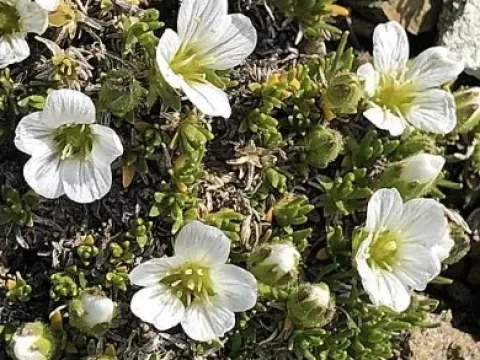
Minuartia
Pseudocherleria
Minuartia (Pseudocherleria) is a genus belonging to the Caryophyllaceae family. These plants are recognized for their mat-forming, perennial habit, native to various temperate and mountainous regions of the Northern Hemisphere, where they thrive in rocky habitats.
What the section contains

Minuartia
The botanical structure of Minuartia is characterized by small, often needle-like leaves arranged in tight, compact rosettes. These rosettes cluster together to create dense, evergreen-like cushions, making them highly valued for ground cover and rock garden applications.
Successful cultivation requires soil with excellent drainage properties. Ideally, the substrate should be sandy or gritty, mimicking the mineral-rich, lean soils of their natural alpine environment. Heavy clays are unsuitable as they promote moisture retention, which can lead to rapid plant decay.
Environmental conditions for Minuartia are centered on full sun exposure. The plant requires high light intensity to maintain its characteristic compact form; inadequate sunlight often leads to etiolation, where stems become elongated and the overall cushion loses its structural integrity.
Agronomic management is relatively simple, requiring minimal intervention. Watering should be sparse, focusing on preventing the plant from drying out completely during extreme drought, while avoiding any waterlogging that could stress the delicate root structure.
Root rot is the primary disease threat for Minuartia, usually triggered by excessive humidity and poorly draining soils. To mitigate this, growers should ensure that the base of the plant is kept dry using a top layer of gravel or crushed stone.
Fungal leaf spots may occur in conditions with limited airflow or persistent dampness. To reduce disease pressure, it is essential to ensure adequate spacing between plants to facilitate proper ventilation throughout the growing season.
Aphids can occasionally infest the young growth during the peak growing season, causing stunted development. Integrated pest management, including regular inspection and the use of targeted treatments, is advised when pest numbers reach critical thresholds.
Winter damage often stems from freeze-thaw cycles combined with high moisture levels. Protecting the plants from winter wetness is often more critical for their survival than protection from cold temperatures alone.
Weed competition is a significant concern during the establishment phase. Since Minuartia is a slow-growing plant, regular weeding is necessary to prevent invasive species from smothering the cushions before they can fully establish themselves.