
Myoporum crassifolium
Myoporum crassifolium
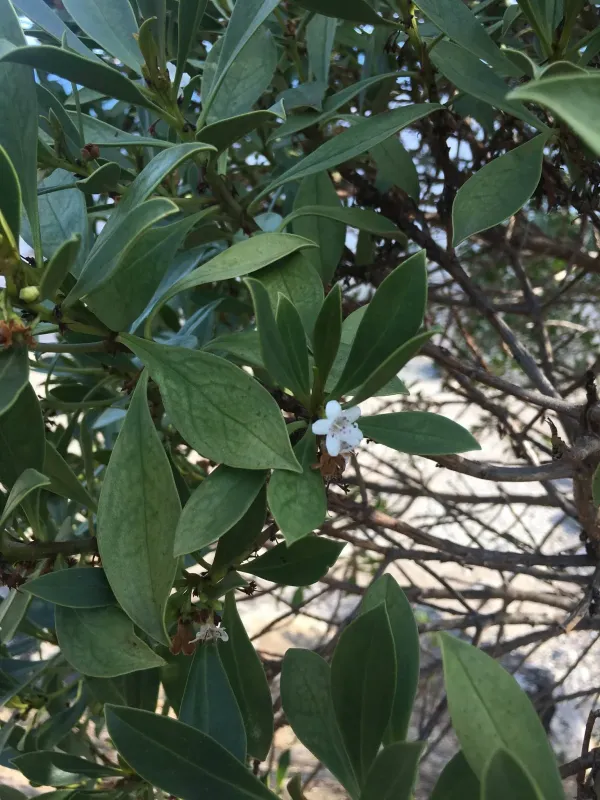
Description
Sowing dates
Myoporum crassifolium belongs to the Scrophulariaceae family. In agricultural and landscaping practices, it is primarily propagated through semi-hardwood cuttings to ensure genetic consistency and faster establishment compared to seed sowing.
The optimal time for taking cuttings is during late spring or early summer. They should be placed in a well-draining rooting medium, such as a mix of peat and perlite, under high-humidity conditions.
Seed propagation is possible but less common due to the extended germination time and the requirement for specific temperature stratification. Seeds should be sown in a greenhouse environment.
When transplanting young plants, it is crucial to ensure that the site has adequate drainage. Spacing should be determined by the intended use; for hedges, plants should be placed close enough to encourage foliage density.
Initial establishment requires consistent moisture. Once the root system is well-developed, the plant becomes notably more resilient and tolerant of varying environmental conditions.
Growing requirements
Myoporum crassifolium thrives in warm, temperate to subtropical climates. It is highly valued for its ability to withstand saline conditions, making it an excellent candidate for coastal landscaping.
The plant requires full sun exposure to maintain its compact form and lush foliage. In shaded locations, it tends to become leggy and less vigorous, leading to a significant reduction in overall aesthetics.
Soil requirements are relatively flexible; however, the plant prefers sandy, well-draining soils with a neutral pH. It does not tolerate waterlogged conditions, which often lead to fatal root rot.
Temperature sensitivity is a limiting factor. While it handles mild frost, prolonged cold spells can cause extensive damage to the branches and foliage, necessitating protection in colder regions.
Minimal fertilization is required for established plants. An annual application of balanced slow-release fertilizer in early spring is usually sufficient to support healthy vegetative growth.
Main diseases and pests
Common pests include aphids and scale insects. These pests often congregate on tender new growth, causing leaf curling and potential stunted development of the affected branches.
Integrated pest management is recommended, starting with mechanical removal or biological controls like ladybugs before resorting to chemical insecticides.
Fungal diseases, such as leaf spot, are often associated with high humidity and poor airflow. Managing the density of the canopy is the most effective preventative measure against such outbreaks.
Root rot remains the most significant threat to the longevity of Myoporum crassifolium. It is almost exclusively caused by overwatering or poor soil drainage, underscoring the need for careful site selection.
Monitoring the plants during hot, humid summer months is crucial. Ensuring that the foliage remains dry and that the root zone is not constantly saturated significantly lowers the risk of pathogen infection.
Harvesting
The harvest of Myoporum crassifolium is non-consumable, focusing instead on pruning and biomass management for plant health. Regular trimming helps maintain the desired shape and stimulates new growth.
For container-grown specimens, maintenance involves periodic pruning to keep the plant within manageable dimensions for indoor winter storage.
Sanitary pruning, which involves removing dead or diseased branches, is typically performed after the flowering season to allow the plant to recover and divert energy to new shoots.
In landscaping, the "harvest" involves seasonal hedge maintenance. Using sharp, clean tools prevents the spread of pathogens and ensures a clean cut that heals quickly.
Because the plant retains its foliage throughout the year, it provides consistent coverage, making it a reliable choice for aesthetic projects that require low-maintenance greenery.