
Musineon
Musineon
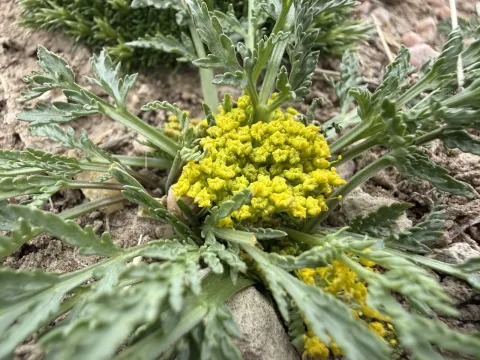
Musineon is a genus of perennial herbaceous plants belonging to the Apiaceae family, native primarily to the prairie and mountain regions of North America.
What the section contains

Musineon
Seed propagation is the primary method of cultivation. Seeds typically require a cold stratification period to break dormancy and ensure uniform germination.
Sowing should be performed in late autumn, allowing the seeds to undergo natural winter chilling. This mimics the environmental cycle necessary for successful spring emergence.
Seeds should be sown at a shallow depth, covered with a very thin layer of fine soil or grit, as they require light and temperature fluctuations to sprout effectively.
Germination is often slow and staggered, so maintaining a clear space free of aggressive weeds is essential for the survival of the seedlings during their first year.
Musineon is highly adapted to exposed, sunny environments. It thrives in well-drained, often rocky or sandy soils characteristic of its native habitat.
The plants are remarkably drought-tolerant once established and prefer areas with low humidity and high air circulation to prevent foliage diseases.
Soil pH should ideally be neutral to slightly alkaline. The plants struggle in heavy, clay-rich soils that retain moisture for extended periods, as they are prone to root rot.
Climate tolerance is significant; the genus is well-adapted to continental climates with extreme temperature swings between winter and summer.
Watering should be strictly regulated and limited to periods of extreme drought, as these plants have adapted to utilize infrequent rainfall efficiently.
Musineon does not have traditional commercial agricultural yield in terms of food or forage production, as it is primarily a wild species.
Its value lies in ecological restoration and sustainable landscaping, where it serves as a nectar source for native pollinators and a structural element in meadow gardens.
Conservationists and restoration ecologists cultivate Musineon to increase biodiversity in degraded prairie habitats and grassland ecosystems.
Small-scale seed production is practiced by specialized nurseries that focus on native species to satisfy the demand for xeriscaping projects.
Overall productivity per unit area is low compared to intensive crops, reflecting its status as a specialized species suited for low-input landscapes.
The primary threat to Musineon cultivation is pathogenic fungi, particularly those causing crown and root rot during wet and humid weather conditions.
Inadequate soil drainage is the most significant risk factor; waterlogged soil will inevitably lead to the loss of mature plants.
Insect pests, including aphids and certain species of leaf-miners, can cause stress to the foliage, though they rarely lead to the total loss of the crop.
Competition from invasive plant species is the most common reason for failure in new plantations; constant monitoring and manual weeding are necessary.
Preventative measures include ensuring proper aeration of the root zone and avoiding over-mulching, which can trap excess moisture against the plant collar.
Harvesting is mainly restricted to seed collection for propagation purposes. This is done by hand when the umbels show signs of darkening and dryness.
Timing is critical, as seeds can disperse quickly once fully mature. Collectors often use bags or paper containers to catch seeds as they ripen.
Once harvested, seeds must be dried in a well-ventilated, cool space to maintain viability for future sowing cycles.
For general maintenance, removal of dead foliage at the end of the growing season is sufficient to keep the growing area clean.
Large-scale mechanical harvesting is not practiced for this genus due to the nature of its growth habit and small-scale demand.