
Merremia hederacea
Merremia hederacea
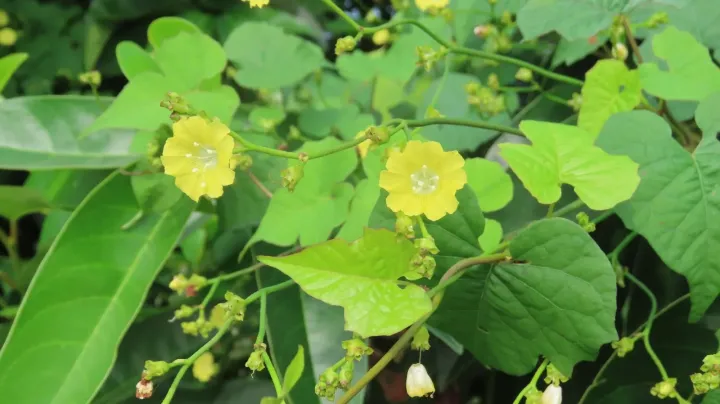
Description
Sowing dates
Merremia hederacea is a climbing herbaceous annual plant belonging to the Convolvulaceae family, widely recognized for its vigorous growth in tropical habitats.
Sowing typically takes place at the onset of the rainy season to ensure that the plant has enough moisture for rapid germination and establishment of its root system.
Seeds should be planted in well-prepared, loose soil at a shallow depth, usually around 1 to 2 centimeters, to allow for optimal seedling emergence.
Planting density is crucial, as the spreading nature of this species requires sufficient space to prevent entanglement and competition between individual vines.
Early-season weed control is essential for successful establishment, as the seedlings are initially slow to grow and can be easily overshadowed by faster-growing weeds.
Growing requirements
This species is highly photophilous and requires full sun exposure to reach its maximum potential in terms of biomass production and reproductive health.
Well-drained, fertile soil with an organic matter content that provides consistent moisture retention is ideal for the cultivation of Merremia hederacea.
While it is tolerant of high humidity, the plant does not perform well in waterlogged soil conditions, which can lead to rapid decay of the root system.
Providing vertical support structures like trellises or companion crops allows the vine to climb, which enhances photosynthesis by exposing leaves to better light.
Temperature is a limiting factor; the plant thrives in tropical and subtropical climates and is highly sensitive to cold stress and frost exposure.
Yield
The primary agricultural interest in Merremia hederacea lies in its ability to produce substantial quantities of green biomass, which can serve as a feed supplement.
Under optimal management, including regular irrigation and judicious fertilization, the plant can yield multiple harvests of foliage during the growing season.
Beyond forage, the plant is studied for its chemical profile, which holds potential for secondary metabolite extraction used in natural product chemistry.
Seed production is consistent when the plant is given adequate space to spread, though manual collection is often necessary to avoid significant harvest losses.
The overall yield is highly dependent on the quality of the supporting infrastructure, which directly impacts the spread and density of the vine canopy.
Main diseases and pests
Fungal diseases, particularly those causing leaf spots and powdery mildew, are prevalent in areas with high humidity or poor canopy ventilation.
Insects, such as leaf-mining beetles and spider mites, can severely impact the quality and quantity of the harvest by damaging the primary photosynthetic tissue.
Root-knot nematodes represent a hidden threat, especially in soils where the plant has been cultivated continuously without proper crop rotation practices.
To maintain a healthy crop, growers should implement sanitation protocols, such as removing debris and infected plants, to prevent the spread of soil-borne pathogens.
Integrated pest management strategies are recommended, focusing on maintaining plant vigor to naturally increase resistance against common pests and environmental stress.