
Kohautia senegalensis
Kohautia senegalensis
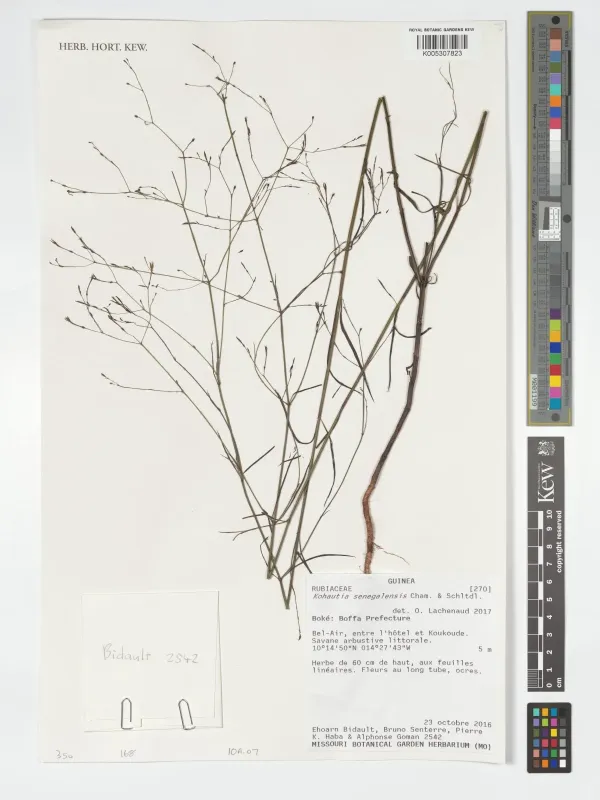
Description
Sowing dates
Kohautia senegalensis is an annual herbaceous plant whose life cycle is strictly tied to seasonal rainfall patterns. In its natural habitat, seeding occurs at the beginning of the rainy season, which provides the necessary soil moisture for seed germination.
The optimal sowing time typically falls between June and July, depending on the start of the monsoon rains in the specific region. Under controlled cultivation conditions, it is crucial to maintain a germination temperature that does not drop below 20–22 degrees Celsius.
The plant's seeds are highly viable but possess a physiological dormancy period that must be considered during artificial stratification. Surface sowing is recommended, as these tiny seeds require a significant amount of light to germinate successfully.
Seeding density is adjusted based on cultivation objectives: for biomass production, a cluster-planting method is practiced. Rows should be spaced at least 30–40 centimeters apart to ensure adequate aeration and sunlight exposure for the plants.
During its growth, the crop demonstrates a rapid development rate, allowing it to form a robust root system before the onset of the dry season. Correct timing of sowing is a key factor that determines the final productivity of the plantation.
Growing requirements
The plant belongs to the Rubiaceae family and is adapted to growth in the semi-arid climate conditions of tropical Africa. It demonstrates high drought tolerance and the ability to survive in nutrient-poor soils.
Kohautia senegalensis prefers well-drained sandy or sandy-loam soils, which are typical for savannah regions. Water stagnation in the root zone is detrimental to the crop; therefore, when choosing a site, it is important to avoid low-lying areas with heavy clay substrates.
Light intensity is a critical factor: the plant requires full sun exposure throughout the entire day. Any shading leads to stem elongation, a decrease in secondary metabolite accumulation, and general degradation of the vegetative mass.
Soil chemical requirements are minimal, although the availability of phosphorus in the initial growth phase positively affects root system development. A neutral or slightly acidic soil pH in the range of 6.0–7.0 is preferred.
- High resistance to extreme temperatures.
- Need for intense solar radiation.
- Adaptation to limited water regimes.
- Minimal need for mineral fertilizer application.
Yield
The green mass yield of Kohautia senegalensis directly depends on rainfall intensity during the growing season. Under optimal moisture conditions, the plant is capable of accumulating a significant amount of vegetative mass suitable for further processing.
Economic use includes the plant's application in traditional medicine and as a fodder resource during the dry season. Seed yield is relatively low, which is associated with the prolonged maturation period of the capsules, requiring careful harvesting.
Average productivity indicators under field cultivation can vary, although exact statistical data depend on local agricultural technologies. Total dry mass yield can reach 2–3 tons per hectare when proper planting density is maintained.
Maximum accumulated biomass is recorded at the start of flowering, when the concentration of active substances in the aerial parts of the plant reaches its peak. This time is considered optimal for beginning planned harvesting.
To increase yield, regular weeding is recommended during the first few weeks after emergence. The crop is sensitive to weed competition, which can quickly suppress its development due to its slow growth rate in the early stages.
Main diseases and pests
Diseases of Kohautia senegalensis in the wild are not well-studied, but under cultivation, root rots pose a primary threat. These generally arise against a background of water regime disturbances and excessive soil compaction.
Pests that affect plants of the Rubiaceae family include various sap-sucking insects, such as aphids and spider mites. These organisms can damage not only the vegetative mass but also reproductive organs, reducing seed productivity.
Soil-dwelling nematodes present a hidden threat, damaging roots and preventing normal water absorption. For prevention, it is recommended to practice crop rotation and use resistant predecessors when planning field operations.
Fungal infections of the leaf surface, caused by excessive air humidity, can trigger spotting and premature leaf senescence. Control measures include timely removal of damaged specimens and ensuring good air circulation.
Biological control is the preferred method, given the plant's use for pharmaceutical purposes. The use of aggressive pesticides is not recommended, as residual chemicals can accumulate in tissues and decrease raw material quality.
Harvesting
Harvesting of Kohautia senegalensis is carried out in the full flowering phase to maximize the concentration of biologically active compounds. The use of mechanized tools is possible provided there is sufficient plantation area.
Collection of seed material requires special attention, as seeds are tiny and prone to shattering when overripe. Harvesting is performed early in the morning, while air humidity is higher, to minimize losses during capsule cutting.
After collection, the plant material undergoes a drying stage in the shade, protected from direct sunlight. This is necessary to preserve the color and therapeutic properties that may degrade when exposed to ultraviolet radiation.
Transportation of raw material is carried out in bags made of natural materials, which ensure normal air exchange. Storage must be conducted in dry, ventilated rooms at a stable temperature to prevent mold formation.
Secondary processing includes sorting and cleaning from foreign impurities, which significantly increases the product's market value. Quality preparation of raw material after harvesting is the key to successful market entry.