
Guzmania lingulata
Guzmania lingulata (L.) Mez
Description
Growing requirements
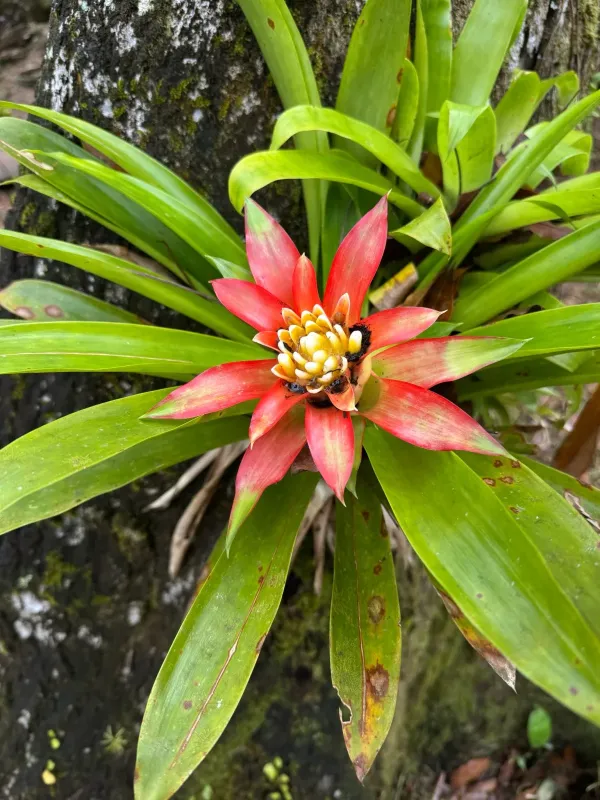
Guzmania lingulata is a member of the Bromeliaceae family, renowned for its ornamental bracts and its natural adaptation as an epiphyte in the rainforests of Central and South America.
The plant grows as a rosette of broad, strap-shaped leaves that function as a water tank, which is a key evolutionary feature allowing the plant to survive in high-canopy environments.
In cultivation, it requires bright, indirect light; direct sunlight should be avoided as it can cause bleaching and scorching of the leaf surfaces, leading to permanent damage.
The growth medium must be well-draining, typically consisting of bark chips, peat moss, and perlite to ensure optimal aeration for the roots, as they are susceptible to suffocation in dense soil.
Environmental management involves maintaining high ambient humidity levels and a consistent temperature range between 20°C and 25°C throughout the active growing season.
Main diseases and pests
Scale insects are among the most persistent pests for this species, attaching themselves to the leaves and leaf bases, and causing significant stress by extracting vital plant fluids.
Mealybugs are another common threat, often found hidden in the center of the rosette or at the base of leaves, where they create cottony masses and weaken the plant's structural integrity.
Root rot, typically caused by Pythium or Phytophthora species, occurs when the drainage is insufficient or when water remains stagnant in the rosette for prolonged periods in cool conditions.
Spider mites frequently infest the foliage when indoor humidity levels drop significantly, resulting in mottled or discolored leaves that lose their aesthetic value over time.
Integrated pest management protocols, including regular cleaning of the leaves and the use of insecticidal soaps, are recommended to control infestations without damaging the sensitive leaf tissues.