
Filago argentea
Filago argentea
Description
Growing requirements
Filago argentea is a herbaceous annual plant belonging to the Asteraceae family. In agricultural research, it is often studied for its resilience and ability to thrive in poor, sandy, or rocky soil conditions where most conventional crops struggle to establish.
The species originated in arid and semi-arid Mediterranean regions. Its habitat typically includes dry pastures, uncultivated lands, and rocky slopes where survival depends on extreme adaptation to water scarcity and high solar irradiance.
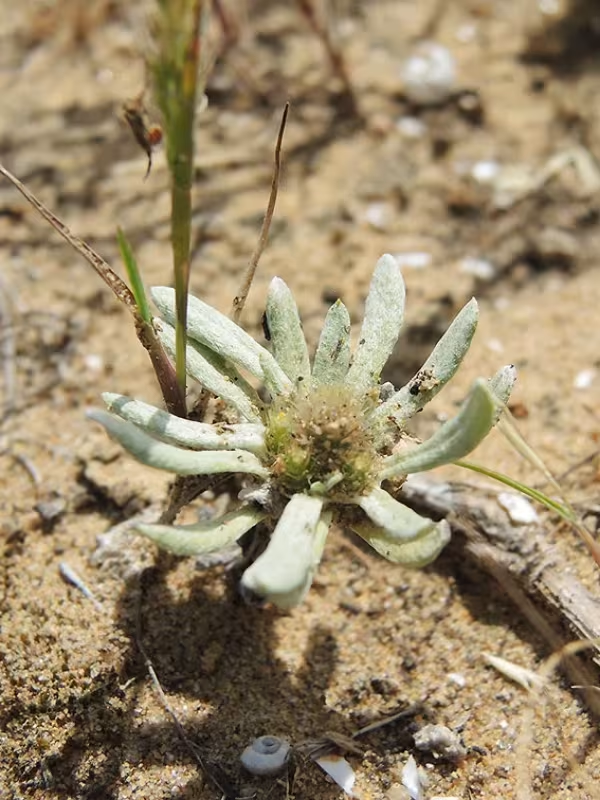
Morphologically, the plant is distinguished by its dense silver tomentum (pubescence) covering the entire surface. This structural feature serves as an evolutionary mechanism to reduce water transpiration and protect the chlorophyll-containing cells from photo-inhibition caused by excessive sunlight.
Regarding soil requirements, Filago argentea prefers well-drained, nutrient-poor substrates. It is a classic xerophyte, meaning it is biologically programmed to complete its life cycle during short windows of favorable moisture, followed by dormancy or the dispersal of seeds during dry seasons.
While not a mainstream cultivated crop, its biology is of interest in land restoration projects. Effective management involves understanding its reliance on light and its inability to compete with dense vegetation, which makes it a natural indicator of low-intensity land use.
Main diseases and pests
Filago argentea is remarkably resistant to most common plant pathogens due to its specialized anatomy. The dense layer of silvery hairs acts as a primary defense, deterring most leaf-feeding insects and preventing the attachment of various fungal spores.
The most significant threat to its survival is the application of synthetic herbicides in surrounding agricultural areas. The species is highly sensitive to chemical intervention, which can cause total population loss in areas where it was previously established.
Waterlogging is a major physiological threat to this species. Because it is adapted to arid environments, excessive soil moisture significantly increases the risk of root rot and other bacterial infections that rapidly colonize its vascular system in wet conditions.
Competition for sunlight from taller, more invasive plant species is another significant factor. In environments where the vegetation structure changes towards more dense types, Filago argentea is often displaced, as it lacks the height to effectively compete for light.
Human-induced environmental degradation, such as soil compaction or massive changes in drainage, poses a threat to the seed bank. The seeds require specific dry and cool conditions to initiate germination, and alteration of these cycles can interrupt its propagation.