
Dogtooth violet
Erythronium japonicum
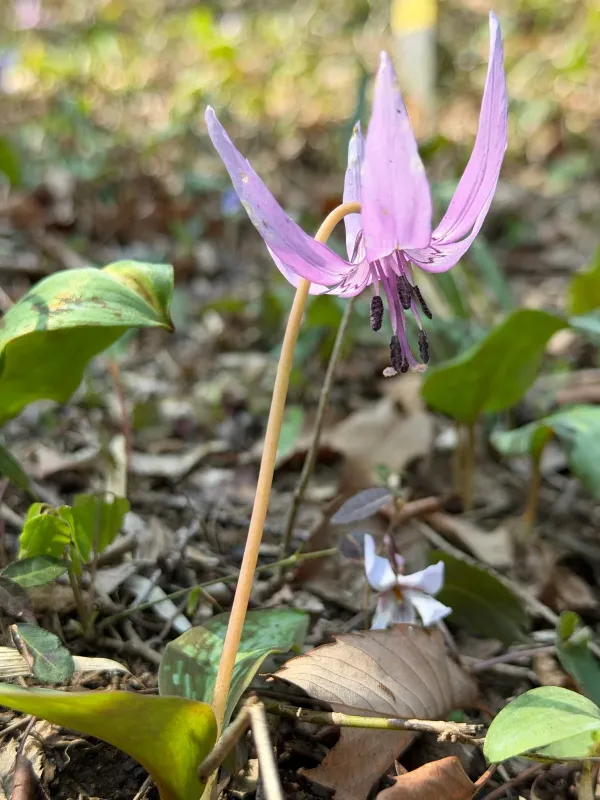
Description
Sowing dates
Sowing of Erythronium japonicum seeds should be carried out immediately after harvest, as they lose viability rapidly if allowed to dry out. The ideal time is late June or early July.
Seeds are sown in open soil or containers at a depth of 1–2 centimeters, ensuring they undergo natural stratification during the winter season to stimulate germination.
Seedlings emerge only in the following spring. For the first few years, the plant develops very slowly, producing only a single narrow leaf, and requires consistent soil moisture.
Vegetative propagation is performed by dividing daughter bulbs during the dormant period, once the foliage has completely yellowed and withered.
Planting density should be carefully managed, with approximately 20–30 bulbs per square meter to ensure adequate air circulation and prevent competition for nutrients.
Growing requirements
Erythronium japonicum is a perennial bulbous plant of the Liliaceae family, preferring the conditions of broad-leaved forests. It thrives in partially shaded areas protected from intense direct sun.
The soil must be rich in organic matter, loose, and have a neutral or slightly acidic pH. Good drainage is essential, as waterlogging during the dormant season causes bulb rot.
The crop has high requirements for humidity and soil moisture during the spring, which is the period of active growth and flowering for this species.
The plant is highly frost-resistant, characteristic of its native habitat in the Far East and Japan, allowing it to survive harsh winters under snow cover.
Adding well-rotted compost is beneficial for development, but excess nitrogen fertilizer should be avoided, as it may lead to fungal infections and succulent, weak growth.
Yield
The primary economic use of Erythronium japonicum is the extraction of starch from its bulbs, which is highly valued in Japan under the name katakuriko.
Yield depends significantly on the age of the plantation, as bulbs reach a harvestable, starch-rich size only after 5 to 7 years of cultivation from seed.
While the aerial parts can be consumed as early spring greens, the main commercial output remains the bulb, where the plant stores its energy reserves.
Quality and starch content are optimized when plants are grown in conditions mimicking the forest floor, allowing for maximum accumulation of carbohydrates in the bulbs.
Although growth is slower compared to staple starch crops, the unique culinary properties of the starch make it a valuable product for niche markets and traditional cuisine.
Main diseases and pests
The main threats to the plant are fungal diseases, such as gray mold (Botrytis) and fusarium, which thrive in conditions of excessive soil moisture and poor ventilation.
Pests like fungus gnat larvae and nematodes can cause significant damage to the underground bulbs, requiring preventative measures in soil preparation.
Small rodents are a serious threat, as the bulbs are a highly attractive food source during the early spring and winter months when food is scarce.
Slugs and snails frequently feed on young foliage, which reduces the photosynthetic area and weakens the plant's ability to store energy for the following season.
Disease prevention is based on crop rotation, weeding, and ensuring excellent soil drainage to eliminate the environmental triggers for infection.
Harvesting
Harvesting is performed only after the foliage has completely died back, indicating that all nutrients have been relocated from the leaves to the bulb.
Care must be taken during harvest to avoid mechanical damage, as injuries to the bulb skin lead to rapid oxidation and increased susceptibility to decay.
After excavation, the bulbs are cleaned of soil, sorted by size, and dried in a shaded, well-ventilated area to prevent moisture-related spoilage.
The resulting starch is known for its excellent gelling properties, making it a preferred thickener in various high-end culinary applications.
Storage requires stable cool temperatures and moderate humidity to ensure the bulbs remain dormant and maintain their quality until processing or replanting.