
Cryptantha holoptera
Cryptantha holoptera
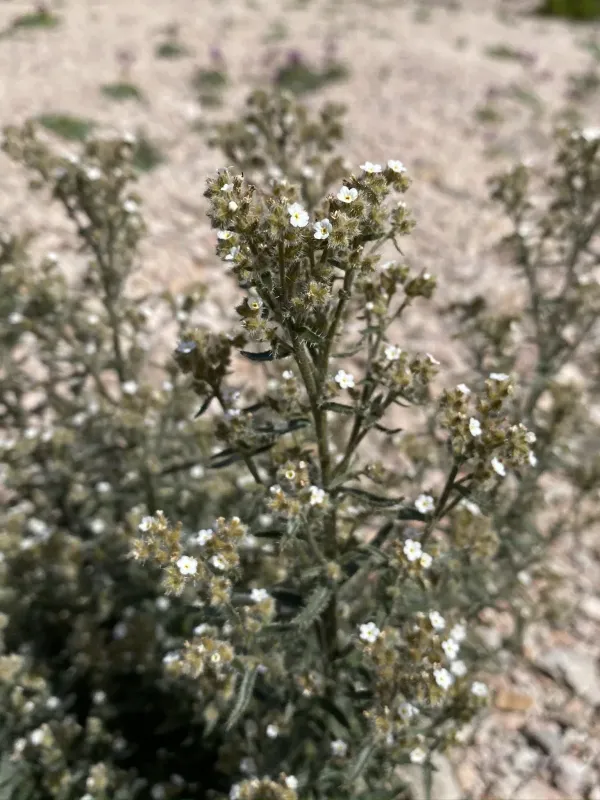
Description
Sowing dates
Cryptantha holoptera is a wild-growing desert annual whose lifecycle is strictly synchronized with seasonal precipitation patterns in its native habitats.
Seeds typically germinate immediately following significant spring rainfall, reacting to both soil moisture levels and specific temperature triggers.
For research or cultivation purposes, seeds require a period of dry stratification to overcome natural dormancy before they are capable of sprouting.
Sowing should be done near the surface of the soil, as the tiny seeds are highly dependent on light exposure to initiate successful germination processes.
Maintaining a well-drained substrate during the initial growth phase is essential to prevent seedling damping-off and ensure proper root development.
Growing requirements
This species belongs to the Boraginaceae family and is highly specialized for life in arid environments where water resources are extremely limited.
The plant thrives in sandy or rocky soils with excellent drainage, which is characteristic of the desert landscapes in the Southwestern United States.
Full sun exposure is a non-negotiable requirement for the photosynthesis and reproductive success of this plant throughout its brief growing season.
It is sensitive to high nutrient levels in the soil, as it has evolved to efficiently extract necessary minerals from nutrient-poor desert substrates.
Tolerance to significant diurnal temperature fluctuations allows the plant to persist in harsh environments where nighttime cooling is drastic.
Main diseases and pests
The primary threats to Cryptantha holoptera are habitat loss and degradation caused by human activity, climate change, and desertification.
Fungal diseases are a significant risk factor if the plants are grown in environments with poor ventilation or high levels of humidity, which contradict their evolutionary adaptation.
Competition from aggressive invasive weeds poses a constant danger, as these plants can easily outcompete native species for limited moisture and space.
While specific insect herbivores exist, they rarely reach densities that would threaten the survival of a healthy wild population of this species.
Physical disturbance of the crust of the soil by off-road vehicles or livestock can lead to the destruction of seed banks and the eventual loss of local populations.