
Ribbed catseye
Cryptantha costata
Description
Growing requirements
Ribbed catseye (Cryptantha costata) is an annual herbaceous plant belonging to the Boraginaceae family. It is a specialist species native to the arid environments of the Southwestern United States, particularly within the Mojave and Sonoran desert regions.
The plant has evolved to thrive in harsh, desert landscapes characterized by extreme heat and periodic water scarcity. It is commonly found inhabiting sandy washes, dunes, and rocky slopes where competition from other vegetation is virtually non-existent.
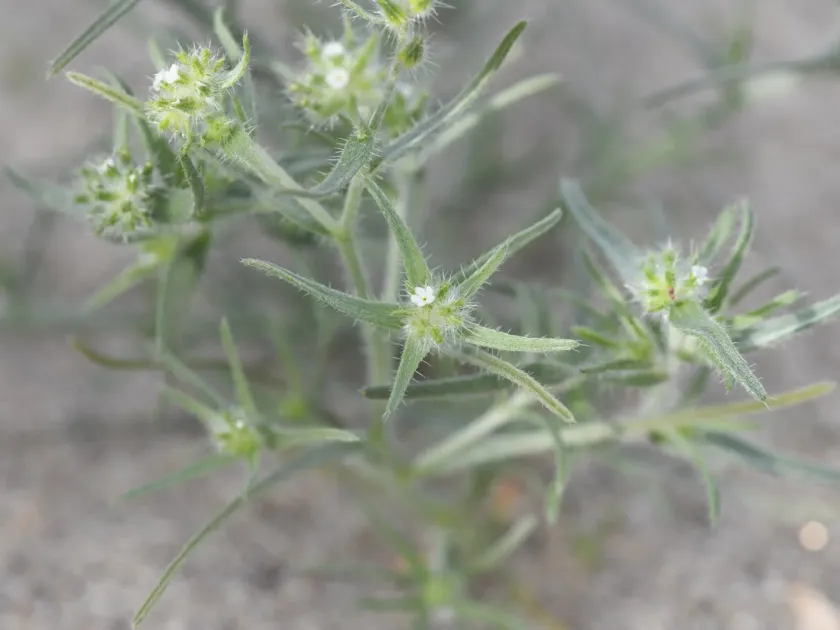
Botanically, it is recognized by its dense, hirsute foliage and stem structure, which serves to reduce water loss through evaporation. The plant produces small, white, sympetalous flowers arranged in scorpioid cymes, a signature trait of the borage family.
Growth requirements emphasize the necessity of high light intensity and exceptionally well-drained soil. Unlike commercial crops, it does not require supplemental irrigation or nutrient-rich substrates, as it is perfectly adapted to the nutrient-poor, alkaline soils of its native habitat.
From a functional perspective, the species serves primarily as an ecological component of desert scrublands. It is not cultivated in agricultural settings, and its agricultural utility is limited to its role in stabilizing soils in fragile desert biomes.