
Cryptantha corollata
Cryptantha corollata
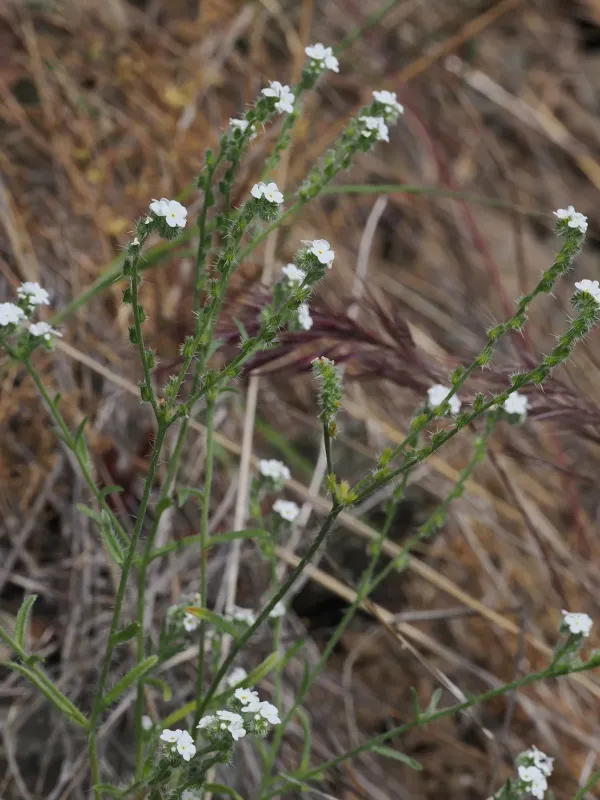
Description
Sowing dates
Cryptantha corollata is an ephemeral species whose life cycle is triggered by spring moisture. For successful germination, seeds require a period of cool, moist conditions, mimicking the early spring environment in its native arid habitats.
Seeds of this species exhibit dormancy, which can be overcome by cold stratification. This process prepares the embryo for emergence when soil temperatures reach 5-10 degrees Celsius, typical for early growth.
Shallow sowing is essential, with a depth of no more than 0.5 to 1 centimeter. Because the seeds are small, deep burial will prevent the seedling from reaching the surface before its energy reserves are exhausted.
Fall sowing is the most effective method, as it allows the seeds to undergo natural winter hardening. This practice generally results in more vigorous and uniform stands when the spring thaw arrives.
Row spacing should be kept at 15-20 centimeters to allow for proper airflow and root development. Excessive density can lead to nutrient competition and an increased risk of fungal infections in the crowded stems.
Growing requirements
Belonging to the Boraginaceae family, Cryptantha corollata is a well-adapted xerophyte. It is specifically evolved to thrive in dry, rocky, or sandy environments where water availability is periodic and limited.
The plant demands well-drained, porous soil. Any substrate that holds moisture for long periods will cause root rot, making it unsuitable for this species. Sandy loams are the ideal choice for cultivation.
Full sun exposure is a mandatory requirement for this plant. In its natural range, it occupies open areas where it can capture maximum solar radiation to fuel its rapid growth during the short wet season.
Temperature requirements are generally moderate, with an optimum range between 15 and 25 degrees Celsius. Extreme heat or prolonged cold periods can prematurely induce dormancy or slow the growth rate significantly.
Soil fertility requirements are minimal. The plant is adapted to nutrient-poor soils and does not require heavy fertilization. In fact, excessive nitrogen levels can be detrimental to its structural integrity and reproductive potential.
Main diseases and pests
Cryptantha corollata is relatively resistant to diseases in its natural arid environment. However, when cultivated under non-native, humid conditions, it becomes susceptible to fungal pathogens and root decay.
Powdery mildew can occur if air circulation is inadequate or if the canopy becomes too dense. Regular monitoring and maintaining proper plant spacing are effective ways to mitigate this threat.
Pests such as aphids may occasionally feed on young, tender leaves. While usually not lethal to established plants, large infestations can stunt the growth and reduce the seed production of the culture.
Slugs and snails represent a danger to emerging seedlings in damper springs. Protecting young plants with coarse mulch or gravel around the base can effectively discourage these gastropod pests.
To ensure healthy development, it is vital to avoid over-irrigation. Proper site selection, which focuses on excellent natural drainage, is the single most important prophylactic measure against common threats.
Harvesting
Harvesting is primarily focused on the collection of seeds for future sowing or research purposes. Seed maturity is indicated by a color change of the seed pods to a light brown or tan shade.
Because the seeds are easily dispersed by wind or physical impact, timing is critical. Harvesting should be performed just before the pods begin to dehisce naturally to maximize the recovery rate.
Post-harvest, seeds must be thoroughly dried in a well-ventilated, shaded area. Removing all moisture from the outer layers is necessary to ensure long-term storage stability and prevent microbial growth.
After cleaning and winnowing to remove chaff, the seeds should be stored in breathable containers, such as paper bags, in a cool and dry location. This preserves their viability for several planting seasons.
Vegetative harvesting is not a standard practice as the plant's life cycle is very short. Current agricultural interest remains centered on the conservation of the species and its role in ecosystem restoration.