
Tangut pea shrub
Caragana tangutica
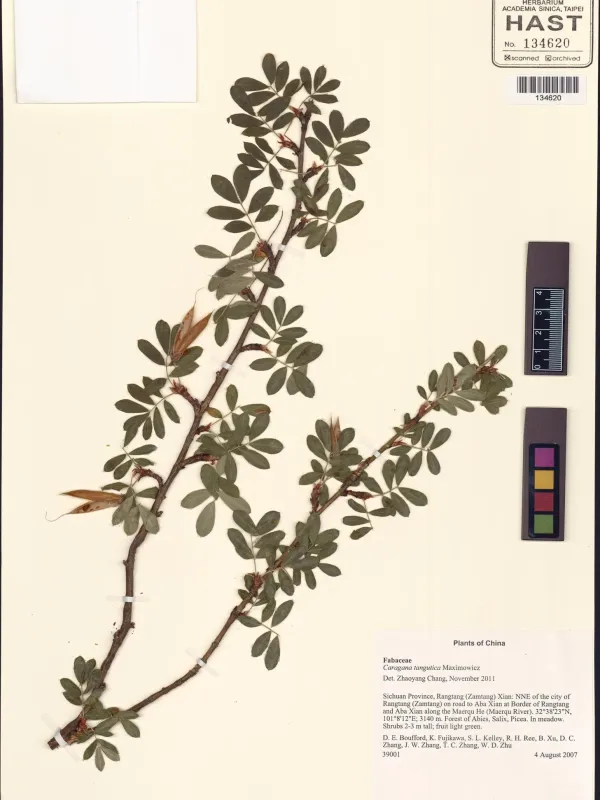
Description
Sowing dates
Sowing of Caragana tangutica is typically carried out using seeds, either in late autumn before the ground freezes or in early spring after scarification.
The seeds exhibit high germination energy when the soil temperature is maintained between 10 and 15 degrees Celsius, promoting uniform and healthy seedlings.
For spring sowing, soaking seeds in warm water for 24 hours is recommended to break dormancy and ensure faster emergence of the primary root system.
Seeds should be planted at a depth of 2 to 3 centimeters, which allows for optimal moisture absorption while protecting the embryo from drying out.
Adequate plant spacing is essential during the initial sowing phase to ensure that the shrub has enough room to establish a robust and deep root system.
Growing requirements
Belonging to the Fabaceae family, the Tangut pea shrub is a remarkably hardy plant naturally adapted to extreme mountain climates and arid environments.
It demonstrates exceptional frost resistance and can tolerate significant temperature fluctuations, making it suitable for regions with harsh continental climates.
The shrub is highly undemanding regarding soil quality, growing successfully in rocky, sandy, or nutrient-poor substrates, which it helps to improve over time.
While it prefers sunny locations, it is capable of surviving long periods of drought once established, thanks to its deep and efficient root architecture.
Like many legumes, it forms a symbiotic relationship with nitrogen-fixing bacteria, allowing it to thrive in soils where nitrogen levels are insufficient for other crops.
Yield
The agricultural value of this species lies in its ability to produce significant biomass, which can be utilized as a secondary forage source for livestock.
Yield productivity is heavily influenced by planting density and the frequency of pruning, which encourages the growth of fresh, nutrient-rich shoots.
In the context of agroforestry and land reclamation, yield is measured by the shrub's contribution to soil stabilization and its effectiveness as a windbreak.
Seed harvesting is conducted when the pods reach full maturity and begin to turn brown, signaling that the seeds inside are ready for collection.
When managed as a plantation, the shrub maintains stable productivity for many years, providing a long-term resource for erosion control and environmental protection.
Main diseases and pests
Caragana tangutica possesses a strong natural resistance to many common diseases, largely due to the presence of secondary metabolites within its tissues.
Occasional infestations by leaf-eating insects can occur, but these are rarely fatal to the plant and are usually limited to specific developmental stages.
Fungal leaf diseases may appear under conditions of extreme humidity or poor air circulation, necessitating regular thinning of the plant's dense branches.
Aphid outbreaks in the early spring can potentially damage young shoots, requiring careful monitoring and the application of organic control methods if necessary.
The best defense against threats is good site management, including maintaining proper spacing to ensure adequate light and airflow throughout the canopy.
Harvesting
Harvesting green biomass for forage is most effective when done via mechanical or manual clipping before the shoots become overly lignified and tough.
For seed production, harvesting must be timed accurately to coincide with full maturity, preventing significant losses caused by natural pod dehiscence.
Collected pods should be dried immediately in a well-ventilated area to ensure that the seeds do not suffer from mold development or moisture-related degradation.
Seed cleaning is performed after the pods are completely dry, involving the separation of seeds from the husks to prepare them for long-term storage or planting.
Monitoring the harvest window is critical, as a delay of even a few days can lead to a substantial drop in seed yield due to the rapid opening of pods.