
Caragana maximowicziana
Caragana maximowicziana
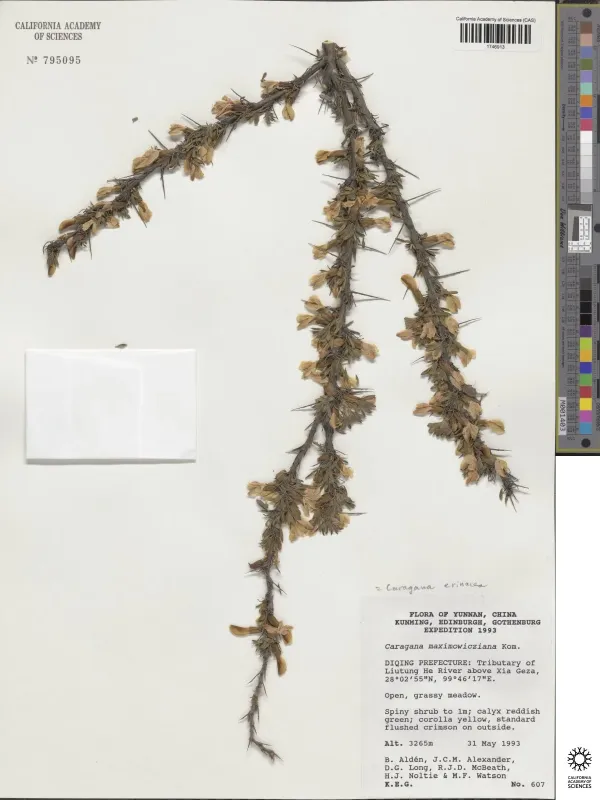
Description
Growing requirements
Caragana maximowicziana is a deciduous shrub belonging to the Fabaceae family. Originating from the mountainous regions of China, this species is highly valued for its extreme resilience to challenging environmental conditions.
The plant thrives in full sun and requires well-drained soil to prevent root issues. It is remarkably tolerant of poor, stony, and nutrient-deficient soils, making it an excellent candidate for landscape restoration.
Its deep root system is a key biological feature that allows the plant to stabilize slopes and survive in arid environments where water accessibility is limited.
As a member of the legume family, it contributes to soil fertility by fixing atmospheric nitrogen, which benefits both the plant itself and the surrounding vegetation in the soil profile.
The species exhibits high winter hardiness, making it suitable for temperate zones where cold tolerance is a critical requirement for long-term survival.
Main diseases and pests
The most common pests affecting this shrub are aphids and spider mites, which typically thrive during extended periods of drought and high temperatures.
Fungal diseases, such as leaf rust or powdery mildew, may occur in conditions with poor air circulation or excessive humidity within the foliage.
To maintain plant health, it is essential to provide adequate spacing between plants to ensure proper airflow and light penetration throughout the crown.
Regular monitoring of the foliage for signs of chlorosis or abnormal growth patterns is recommended to catch potential infestations or nutritional deficiencies early.
Integrated pest management, including pruning infected branches and localized insecticide application, is usually sufficient to handle any occasional outbreaks.