
Blepharis subvolubilis
Blepharis subvolubilis
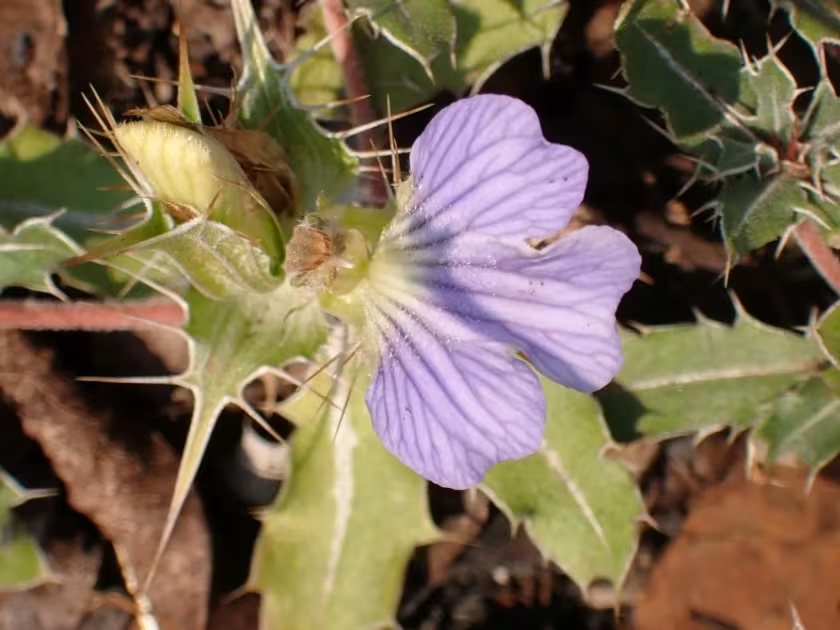
Description
Sowing dates
Blepharis subvolubilis is a member of the Acanthaceae family, characterized by its resilience in semi-arid environments where other forage crops struggle to survive.
Sowing occurs primarily at the onset of the rainy season, ensuring that the seeds have sufficient moisture to establish a root system before the dry spell begins.
The seeds are typically drilled into well-prepared soil at a shallow depth of approximately 1–2 cm, as they require specific light and moisture triggers to germinate.
During the initial emergence phase, the plant requires consistent moisture, although once established, it demonstrates high drought tolerance.
Row spacing is usually set between 40 to 50 cm, allowing for adequate plant development and light penetration throughout the foliage.
Growing requirements
The crop requires full sun exposure to thrive and maximize biomass accumulation; it is strictly an heliophyte and does not tolerate shaded conditions.
Soil type should ideally be sandy or loamy with excellent drainage properties to prevent the accumulation of water, which can trigger fungal root rot.
The plant performs best in a temperature range of 25–35 degrees Celsius, thriving in areas where summer heat is persistent and intense.
Soil nutrient requirements are relatively low, making this species suitable for marginal lands where chemical fertilizers are not economically viable.
Effective management includes timely weed control in the first two months, as young plants have a slow early growth rate compared to local grasses.
Yield
Yield production of Blepharis subvolubilis is measured by total green biomass, which is particularly valuable during the dry seasons when other forage sources are unavailable.
The plant exhibits a remarkable ability to regenerate following grazing, provided that the grazing intensity is monitored and the root crown is not physically uprooted.
Farmers use the plant primarily as a forage crop for livestock, as it maintains its nutritional value longer than many seasonal grass species.
Strategic harvesting cycles can increase total annual biomass, allowing for sustainable feed production in ecologically fragile regions.
Integration into agro-pastoral systems helps stabilize soil surfaces, as the plant acts as a deterrent to erosion due to its hardy root network.
Main diseases and pests
The primary threats include fungal diseases such as leaf spots and root decay, which typically occur during periods of uncharacteristic high humidity.
Insect pests, including orthopterans, can cause significant defoliation, which severely impacts the plant's capacity to photosynthesize and store energy.
Root-knot nematodes can also be a limiting factor in loose sandy soils, weakening the plant's structural integrity and drought resistance.
Integrated pest management strategies are recommended, focusing on early detection rather than the widespread application of chemical controls.
- Maintain appropriate planting density to increase air circulation.
- Rotate crops where possible to reduce soil-borne pathogen load.
- Monitor for insect activity during the peak growth season.