
Dyer's Woodruff
Asperula tinctoria
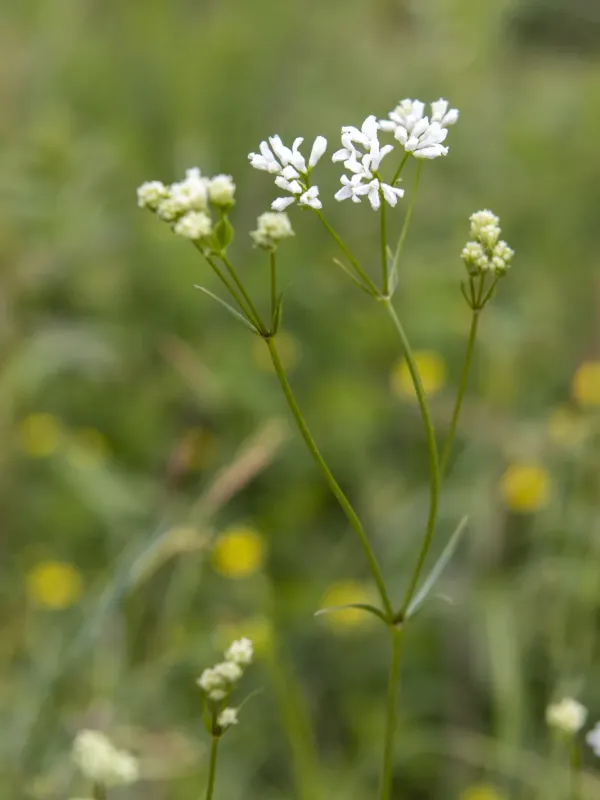
Description
Sowing dates
Sowing of Dyer's Woodruff is best performed in late autumn or early spring, immediately after snowmelt, as the seeds require stratification for uniform germination.
The sowing depth should be no more than 1–2 centimeters, given the small size of the seeds, to ensure optimal contact with the moist soil.
An optimal planting pattern involves row spacing of 30 to 45 centimeters, which facilitates subsequent maintenance and weeding of young plants.
During the first year of life, the crop develops quite slowly, growing a basal rosette of leaves and establishing a powerful root system.
Full seedlings typically appear 3 to 4 weeks after sowing, provided there is sufficient moisture in the upper soil horizon.
Growing requirements
Dyer's Woodruff belongs to the Rubiaceae family and is a perennial herbaceous plant with an upright, slightly branched stem.
The crop prefers well-lit areas, although it can tolerate partial shading for part of the daylight hours.
It is moderately demanding regarding soil conditions, thriving best in light loams and sandy soils with a neutral or slightly alkaline pH.
The plant possesses high frost resistance and is capable of successfully overwintering in temperate climates without additional covering.
Agronomic practices require keeping the soil loose and timely weeding, especially during the plant's initial rooting phase.
Yield
The main raw material is the plant's rhizome, where dyes, specifically anthraquinone derivatives, accumulate over time.
The maximum pigment content in the roots is reached in the 3rd or 4th year of vegetation, which determines the harvest cycle for commercial plantations.
The yield of raw root mass can vary depending on soil fertility and plant density per unit of area.
Industrial use of Dyer's Woodruff focuses on producing stable red and pink dyes for the textile industry and artistic crafts.
With proper cultivation technology, one hectare of plantation can produce a stable annual increase in biomass suitable for extraction.
Main diseases and pests
Dyer's Woodruff is relatively resistant to most common agricultural pests, but it can suffer from waterlogging.
The main danger in wet years is fungal diseases of the root system, such as root rot, caused by stagnant water.
Among pests, wireworm larvae cause the most damage, attacking the underground stem parts and roots in young plants.
During active growth, signs of powdery mildew may appear on leaf blades, requiring preventive treatment with sulfur-based fungicides.
To prevent the spread of infections, it is necessary to follow crop rotation and avoid overcrowded plantings to ensure proper ventilation.
Harvesting
Root harvesting is carried out in autumn at the end of the growing season, when the above-ground part of the plant begins to wither.
The roots are carefully extracted from the soil using mechanical scoops or plows, ensuring the integrity of the rhizomes is maintained.
After excavation, the raw material must be thoroughly cleaned of soil residue, washed in running water, and dried.
Drying is performed in well-ventilated rooms or specialized dryers at temperatures not exceeding 45 degrees Celsius to preserve pigment quality.
Finished raw material is stored in dry, dark warehouse facilities to protect it from moisture and direct ultraviolet radiation.