
Umbellate whitebeam
Aria umbellata
Description
Growing requirements
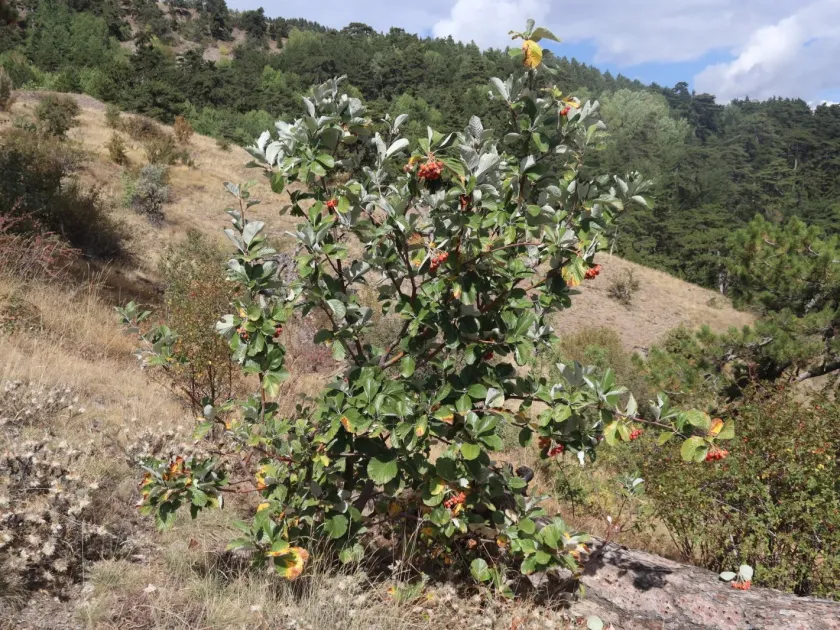
The umbellate whitebeam (Aria umbellata) is a perennial deciduous shrub or small tree belonging to the Rosaceae family. Often classified within the Sorbus genus broadly, this species is noted for its distinct morphological traits, particularly its dense, umbrella-shaped crown.
Native to the mountainous regions of Southern Europe and the Mediterranean, the tree is naturally adapted to limestone, rocky soils, and harsh environmental conditions. Its evolutionary history has made it highly resilient to drought and poor soil quality.
This crop requires full sun exposure to maintain its characteristic compact form and to ensure optimal flowering and fruiting. It thrives in well-drained, alkaline soils and performs poorly in waterlogged environments where root development is restricted.
Agronomic management focuses on structural pruning, typically performed in late winter or early spring. This helps the plant maintain its aesthetic shape while encouraging the development of productive wood for the following season.
In terms of climate, the umbellate whitebeam is hardy and tolerant of significant seasonal temperature fluctuations. It is an excellent choice for xeriscaping or low-maintenance gardens where soil moisture might be inconsistent.
Yield
The fruits of the umbellate whitebeam are a valuable agricultural resource. While often tart when fresh, they are rich in vitamins, pectins, and sugars, making them suitable for traditional culinary processing such as jams, jellies, and preserves.
Production cycles typically start when the plant reaches maturity, usually 5 to 6 years after planting. Yield consistency is dependent on adequate sunlight and minimal competition from weeds in the root zone during the primary growth phase.
Beyond fruit production, the species holds significant value in urban landscaping. Its resilience to city pollution, combined with its distinct silver-backed leaves and seasonal fruits, makes it a preferred choice for street and park plantings.
The timber is dense, fine-grained, and durable, allowing for artisanal applications in woodworking. Although not a primary industrial timber crop, it serves as a sustainable source for high-quality small woodcrafts and garden implements.
The crop's dual-purpose nature—ornamental and productive—enhances its economic viability for small-scale orchards and hobbyists interested in native European plant biodiversity.
Main diseases and pests
The umbellate whitebeam is susceptible to common fungal pathogens, including scab (Venturia spp.) and various leaf rusts, especially in regions with high spring humidity. Proper crown management is essential to reduce these risks.
Insect pests, such as aphids and specialized leaf miners, can occasionally cause damage to the foliage. Integrated Pest Management (IPM) strategies, including monitoring and biological control, are recommended over blanket chemical treatments.
To mitigate disease outbreaks, it is crucial to ensure adequate airflow within the canopy. Regular removal of deadwood and infected twigs helps prevent the overwintering of pathogens that could compromise the tree's health.
Soil management plays a significant role in plant vitality. Avoiding nitrogen over-application prevents excessively soft growth that is more attractive to sap-sucking insects and susceptible to powdery mildew infections.
- Routine canopy thinning to improve aeration
- Prompt disposal of infected leaf litter
- Regular monitoring during the blooming season
- Balanced fertilization to boost natural resilience
- Use of organic mulch to regulate soil moisture