
Amyema quandang
Amyema quandang
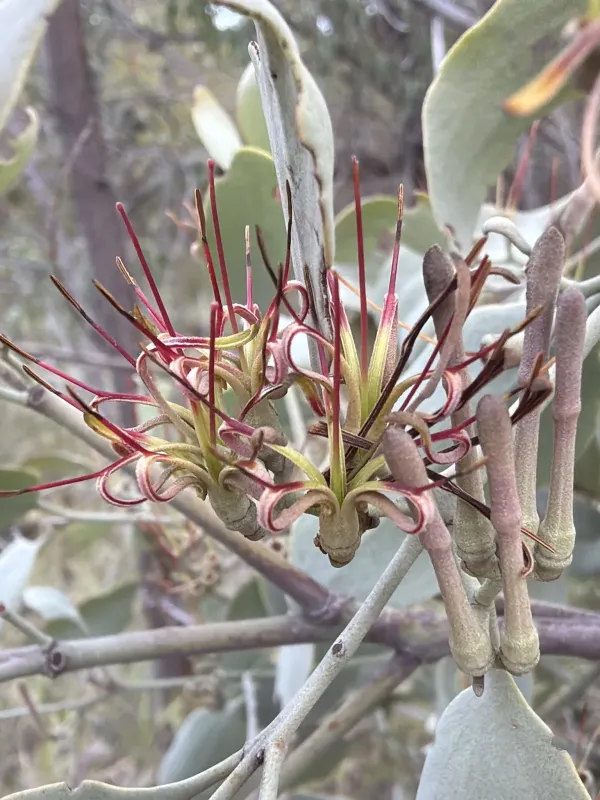
Description
Growing requirements
Amyema quandang is a species of hemiparasitic shrub belonging to the Loranthaceae family. It is not an agricultural crop but rather a wild plant that derives nutrients by parasitizing specific host trees, predominantly species of Acacia.
The native habitat of this species is confined to the arid and semi-arid regions of Australia. The plant has evolved specific physiological mechanisms to survive in environments where water availability is highly inconsistent.
Botanically, it features leathery, simple leaves and tubular flowers that are evolutionarily adapted to be pollinated by honeyeaters and other native Australian birds. Its survival depends entirely on the formation of haustoria.
The haustorium is a specialized root-like organ that penetrates the bark and xylem of the host tree. This biological connection allows the plant to extract water and dissolved mineral nutrients from the host's vascular system.
In terms of ecological requirements, the species necessitates a stable host population. It thrives in open woodland and shrubland environments where the host trees provide sufficient structural support and nutrient flow.
Main diseases and pests
The primary threat to Amyema quandang populations is the large-scale clearance of native vegetation and host trees for agricultural or infrastructure development. Habitat fragmentation directly disrupts its life cycle.
Pests and diseases that target the host trees, such as wood-boring insects or severe fungal infections, indirectly jeopardize the stability and survival of the parasitic plant.
Climate change, specifically prolonged droughts, can weaken host trees to a degree where they can no longer support the energetic demands of the parasite, leading to the desiccation of the shrub.
Invasive species and overgrazing by herbivores also contribute to the degradation of the ecosystems where this plant is found, leading to a reduction in the density of suitable host individuals.
Additionally, improper management of wildland areas may favor the spread of more aggressive competing epiphytes, which can outcompete Amyema quandang for space on the host tree's branches.