
Amyema miquelii
Amyema miquelii
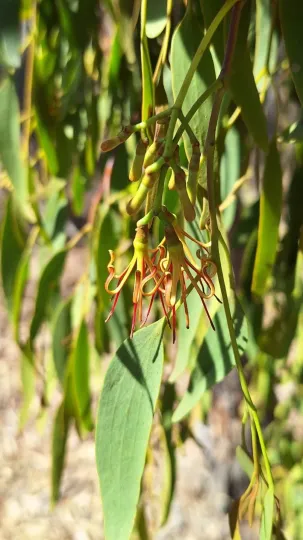
Description
Growing requirements
Amyema miquelii, commonly known as the Box Mistletoe, belongs to the Loranthaceae family. It is a perennial hemiparasitic plant that grows on the branches of woody hosts, primarily species within the Eucalyptus genus, by anchoring itself with a specialized structure called a haustorium.
The plant is native to Australia, with an extensive range across the southern and eastern parts of the continent. It occupies various woodland and forest types, where it has evolved to tap into the vascular systems of trees to extract water and essential minerals for its survival.
Botanically, A. miquelii is characterized by its leathery, photosynthetic leaves and branching habit that often creates dense, shrub-like clumps within the host tree's canopy. Its survival strategy combines autotrophic photosynthesis with nutrient acquisition from the host, classifying it as a hemiparasite.
Regarding environmental requirements, this species favors well-lit habitats with access to consistent sunlight. It thrives in open woodland settings where the host trees are sufficiently spaced to allow for high light intensity, which is critical for the plant's metabolic and reproductive processes.
While not a commercial crop, A. miquelii is integral to forest health. It provides a vital food source in the form of nectar and fruits for various native bird species, such as honeyeaters. Its presence creates micro-habitats that contribute to the overall biological diversity within Australian forest ecosystems.
Main diseases and pests
The primary threat to Amyema miquelii populations is the loss of old-growth host trees. Large, mature trees provide the stable environment and canopy complexity that A. miquelii requires to establish itself and reproduce successfully over long periods.
Pests affecting this species include several specialist insects, particularly butterfly and moth larvae that have evolved to feed exclusively on mistletoe tissues. Heavy infestations can lead to significant defoliation, which hampers the plant's ability to produce flowers and fruits.
Pathogenic threats are often linked to fungal infections that can affect both the parasite and the host branch at the site of attachment. Environmental stress, such as prolonged drought, can further compromise the health of the host tree, making the mistletoe cluster more susceptible to disease.
The reproduction of this plant is strictly dependent on avian vectors, as the seeds are usually dispersed by birds that eat the fruits and subsequently deposit the seeds on other branches. Any decline in the population of these specific seed-dispersing birds directly threatens the future colonization of the species.
Climate change poses a significant long-term risk. Altered precipitation patterns and increased fire frequencies in Australian woodlands can lead to the widespread destruction of host trees, thereby eliminating the habitat necessary for A. miquelii to survive and proliferate within its native range.