
What to check in agricultural machinery before the season: a practical checklist to reduce downtime
The start of a new season for an agricultural machinery owner is not just about preparing for fieldwork, but also about checking the machines' readiness for sustained heavy loads.
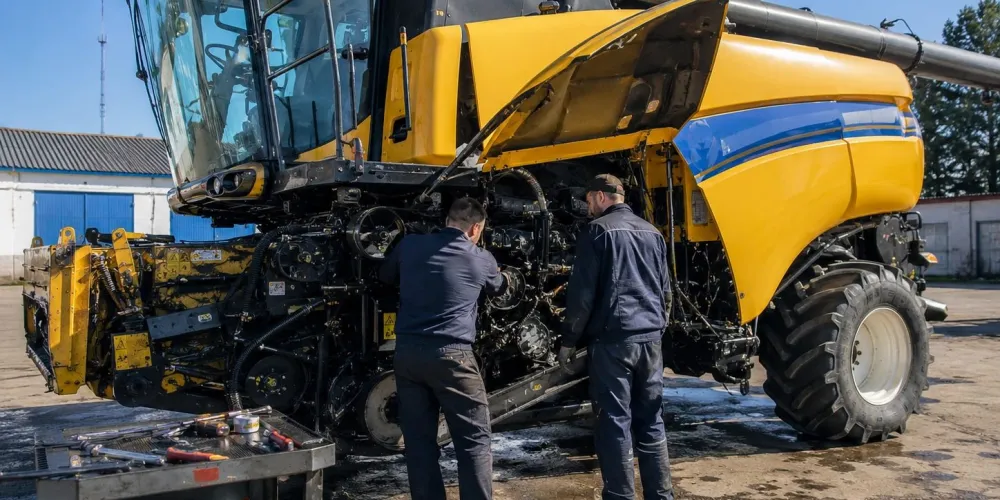
The start of a new season for an agricultural machinery owner is not just about preparing for fieldwork, but also about checking the machines' readiness for sustained heavy loads. Tractors, combine harvesters, loaders, trailed, and mounted implements can operate almost continuously for several months. If a malfunction is discovered during sowing or harvesting, even a minor issue can lead to equipment downtime, delayed technological operations, and additional costs.
That is why pre-season maintenance should be viewed not as a formal procedure, but as a way to reduce the risk of emergency repairs during the busiest time of the year.
A comprehensive inspection should cover more than just the engine and undercarriage. Special attention must be paid to the hydraulic system, transmission, electrical equipment, working parts, implements, fasteners, and components that experience the highest mechanical stress.
The importance of pre-season agricultural machinery inspection
During storage, machinery does not necessarily remain in the same condition as it was when parked. Rubber seals may lose elasticity, contacts can oxidize, batteries may lose charge, and working fluids may change their properties.
Furthermore, some defects arise gradually during the previous season. Play in a joint, a small oil leak, increased bearing noise, or a slight decrease in hydraulic performance may initially have almost no effect on the machine's operation. However, when the load increases, the problem can quickly escalate into a serious malfunction.
A particularly dangerous situation occurs when several components have a small degree of wear simultaneously. Each individual problem may seem minor, but the cumulative effect of such defects during intensive use increases the strain on the machine.
Before the season starts, it is advisable to conduct a full inspection and compile a list of identified shortcomings. Afterward, you can determine which work needs to be performed immediately and which can be scheduled for future maintenance.
1. Engine and fuel system
The engine is one of the most heavily loaded units in agricultural machinery, so its preparation should not be limited to checking the motor oil level.
Before the season starts, you should check:
the level and condition of motor oil;
oil filter;
air filter;
fuel filters;
condition of fuel lines;
tightness of connections;
cooling system;
condition of the radiator;
fan and drive belts;
presence of abnormal noises;
stability of engine operation in different modes.
Special attention should be paid to the cooling system. A dirty radiator, insufficient coolant circulation, or a faulty thermostat can cause overheating during prolonged operation.
Before the season, you should also inspect areas for potential leaks of oil, fuel, and coolant. Even a small stain under the machine after being parked can be a signal that the integrity of a specific unit has already been compromised.
2. Hydraulic system
The hydraulics of modern agricultural machinery ensure the operation of a large number of mechanisms: implements, working parts, lifting mechanisms, hydraulic cylinders, and other actuators.
During the pre-season inspection, it is necessary to pay attention to:
level and condition of hydraulic fluid;
condition of the hydraulic tank;
tightness of connections;
high-pressure hoses;
hydraulic cylinders;
hydraulic pumps;
hydraulic control valves;
speed of operation of working mechanisms;
abnormal noises and vibrations;
heating of hydraulic fluid.
It is especially important to inspect high-pressure hoses. Cracks, abrasions, blistering, or damage near the connection points should not be ignored. A burst high-pressure hose during operation can not only stop the machine but also create a dangerous situation for the operator.
No less important is the performance of the mechanisms under load. If a hydraulic cylinder acts jerkily, a working part lowers faster than before, or the mechanism loses force, this may indicate internal leaks or wear of hydraulic system components.
3. Transmission and undercarriage
The transmission transfers power from the engine to the drive mechanism, so its condition directly affects the machine's ability to operate under load.
Before the season, it is desirable to check:
level and condition of transmission oil;
gearbox;
clutch;
driveshafts;
gear reducers;
axles;
bearings;
articulated joints;
drive shafts;
condition of tires or tracks.
During a test run, it is worth paying attention to abnormal sounds, vibration, thumping when shifting gears, and unusual heating of aggregate housings.
If problems with gear shifting, slipping, increased noise, or transmission overheating were already observed during the previous season, do not delay diagnostics until the fieldwork begins.
4. Electrical equipment and battery
The electrical system of modern agricultural machinery is responsible for more than just starting the engine. Lighting, sensors, control systems, controllers, instruments, and auxiliary equipment all depend on it.
Before the season, you should check:
battery;
terminals;
alternator;
starter;
fuses;
wiring;
lighting;
sensors;
connectors;
electrical connections.
After long periods of storage, problems with contacts are especially common. Moisture, dust, corrosion, or insulation damage can cause unstable operation of individual systems.
If the equipment is equipped with electronic control systems, it is advisable to check for any error messages or warnings on the dashboard.
5. Working parts and implements
A malfunction of a working part may not stop a tractor or other machine completely, but it can significantly impair the quality of the technological operation performed.
Depending on the type of equipment, it is necessary to check:
fasteners;
pins;
bushings;
hinges;
blades;
tines;
working discs;
shafts;
bearings;
protective covers;
hydraulic drives;
welded joints.
For implements, the absence of excessive play is of particular importance. Worn bushings or pins increase the free play of mechanisms and can accelerate the wear of adjacent parts.
It is also necessary to check the condition of mounting points. Cracks, metal deformation, or signs of fatigue failure are best addressed before intensive operation begins.
6. Bearings, shafts, bushings, and other mechanical connections
Particular attention should be paid to parts that constantly operate under friction, rotation, or impact loads.
These include:
bearings;
bushings;
shafts;
axles;
pins;
keyway connections;
mating surfaces;
gears.
The wear of such parts cannot always be determined visually. For example, slight play in a shaft or bushing can increase over time, leading to uneven loading and damage to other components.
If characteristic thumping, vibration, or uneven rotation appears during the machine's operation, you must identify the source of the problem rather than simply replacing the most obvious part.
7. Braking system, steering, and safety
Before the season starts, one cannot ignore the systems on which the safety of the operator and people working near the equipment directly depends.
You need to check:
brake operation;
brake mechanisms;
hydraulic or pneumatic circuits;
steering;
play;
wheel fastenings;
mirrors;
lighting;
audible signals;
emergency systems.
If the machine is operating on the premises of an enterprise or near other people, the integrity of safety systems must be one of the priorities of pre-season preparation.
8. Working fluids and lubricants
Even a perfectly functioning mechanical unit can operate unstably if inappropriate or contaminated fluid is used.
Before the season, you should check:
motor oil;
transmission oil;
hydraulic fluid;
coolant;
grease for hinges;
other technical fluids according to the manufacturer's recommendations.
It is important to consider not only the level but also the state of the fluid. The presence of foreign impurities, changes in color or smell, or the appearance of metal particles can be a cause for additional diagnostics.
Replacing fluid "just in case" does not always solve the problem. If it gets dirty quickly after replacement, you need to look for the cause—for example, component wear, ingress of contaminants, or system damage.
What to do if a malfunction is detected during inspection
Identifying a defect before the season starts is a positive result of the inspection. It is much easier to plan repairs during a period of minimal machinery workload than to look for a service center in the middle of fieldwork.
At the same time, not every problem means the need for a complete replacement of a unit.
First, you need to determine the nature of the malfunction, the degree of wear, and the possibility of further operation. For complex units, it is advisable to carry out defect detection, after which you can determine whether repair of an individual part, refurbishment of the unit, or its complete replacement is required.
If problems with hydraulics, working mechanisms, or other units of special machinery are detected during inspection, diagnostics and repair should be entrusted to a specialized service center, for example, RGS Ukraine.
This approach allows for assessing the actual condition of a unit before intensive operation begins. For agricultural machinery, this is especially important because repairs performed in advance are usually easier to organize than emergency recovery of a machine in the middle of the season.
Which malfunctions should not be delayed
There are several categories of defects that are better to fix before active work begins.
These include:
leaks of fuel, oil, or hydraulic fluid;
damaged high-pressure hoses;
critical play in hinges;
cracks in load-bearing parts;
brake malfunctions;
steering problems;
engine overheating;
unstable transmission operation;
strong vibration;
abnormal metal noise;
drop in hydraulic system performance;
deformation or damage to working parts.
It is undesirable to rely solely on the principle of "if it works, don't touch it." Some defects progress gradually, and fixing them after a major breakdown may require significantly more time and money.
Pre-season checklist
To not miss important operations, it is convenient to carry out pre-season preparation according to a list.
Engine:
check oil;
inspect filters;
check cooling system;
inspect belts and hoses;
check fuel system.
Hydraulics:
check working fluid level;
inspect high-pressure hoses;
check hydraulic cylinders;
inspect connections;
check mechanism operation under load.
Transmission and undercarriage:
check oils;
inspect gear reducers;
check bearings;
assess play;
check the condition of tires or tracks.
Electrical:
check battery;
clean contacts;
check starter and alternator;
check lighting and sensors.
Implements:
inspect pins and bushings;
check fastenings;
check working parts;
inspect welded seams;
check drives.
Safety:
check brakes;
steering;
emergency systems;
signals;
protective covers.
How to organize preparation without unnecessary expenses
Rational pre-season preparation does not mean that every unit needs to be disassembled or replaced preventively.
It is more convenient to divide all identified problems into three groups.
First—critical malfunctions. These are defects that can lead to an accident, machine stoppage, or damage to other units. They must be fixed before work begins.
Second—malfunctions that affect productivity. For example, a decrease in hydraulic operating speed, increased play, or unstable operation of a certain mechanism. Such problems should also be fixed in advance.
Third—minor defects and scheduled maintenance. They can be included in the maintenance schedule if they do not affect the machine's safety and performance.
This approach allows you not to waste money on unnecessary replacement of functional parts while not ignoring problems that can lead to serious downtime.
Preparing agricultural machinery for the season is a comprehensive inspection of the engine, transmission, hydraulics, electrical equipment, undercarriage, working parts, and safety systems.
The main goal of such an inspection is not just to find malfunctions, but to identify risks and plan necessary work in advance. It is especially important to pay attention to small leaks, play, abnormal noises, vibration, overheating, and changes in the operation of hydraulic mechanisms.
For an enterprise or farm, a few hours spent on diagnostics before the season can be significantly cheaper than forced downtime during a period of maximum load.
Regular inspection, timely maintenance, and repair planning allow for extending the service life of units and assemblies, reducing the risk of emergency breakdowns, and ensuring the readiness of agricultural machinery for intensive work.
Editorial team agronom.info
Materials are prepared by the portal's agronomists and editors. We use only trusted sources: Ukrainian agricultural universities, variety registries, open scientific publications.
Related articles
Not yet comments. Be the first!
Comments · 0