
How to choose a potato digger for a walk-behind tractor: types, tips, and mistakes
Buying a potato digger is not always justified — much depends on the scale of work and the conditions of the plot. If you are dealing with 5–6 ares of loose soil, where harvesting takes a couple of weekends, manual…
When a potato digger is really needed and what task it solves
Buying a potato digger is not always justified — much depends on the scale of work and the conditions of the plot. If you are dealing with 5–6 ares of loose soil, where harvesting takes a couple of weekends, manual labor is still acceptable. However, on an area of 10–15 ares, the situation changes: harvesting can take 2–3 days, and the physical load becomes critical. With volumes exceeding 20 ares, crop loss and fatigue become the main problems without mechanization.
The difference between manual and mechanized harvesting is felt immediately:
time is reduced by 3–5 times;
tuber damage is reduced to 5–10% compared to 20–30% when using a shovel;
the load on the back and joints is reduced;
the uniformity of potato lifting increases.
Without a suitable potato digger, typical difficulties arise: some tubers remain in the ground, especially in dense plots, the equipment may get stuck, and if the depth is incorrect, the potatoes are sliced. Damp soil further complicates the process — the earth sticks, and efficiency drops.
Simple models are suitable for owners of small plots with light soil. If the plot is larger, or there is loam or high humidity, it is worth looking at vibration or conveyor solutions. Here, not only the type selection is important, but also compatibility with the walk-behind tractor — otherwise, even an expensive potato digger for a walk-behind tractor will not show the expected result.
Types of potato diggers: construction, pros, and limitations
In practice, the differences between types of diggers manifest not only in the design but also in the results of work on specific soil. The main types are also used in Belarus, especially with popular MTZ, Neva, and Belarus walk-behind tractors.
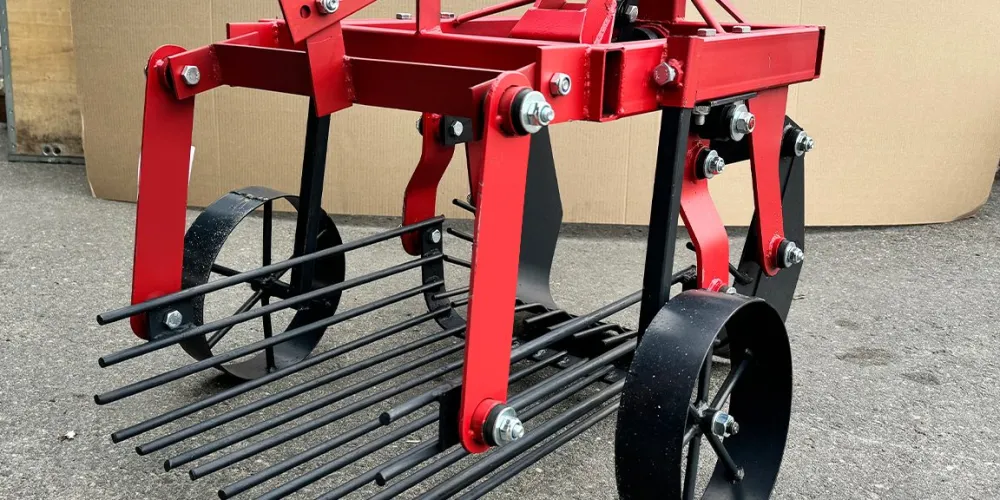
Fan or share-type. The simplest models: a blade cuts through the layer of soil, and rods separate the potatoes in a "fan" shape. Their advantage is low price and simplicity. But there are nuances: losses can reach 15–20%, especially on dense soil, and some tubers remain in the ground. Such models are suitable for light sandy plots and small volumes.
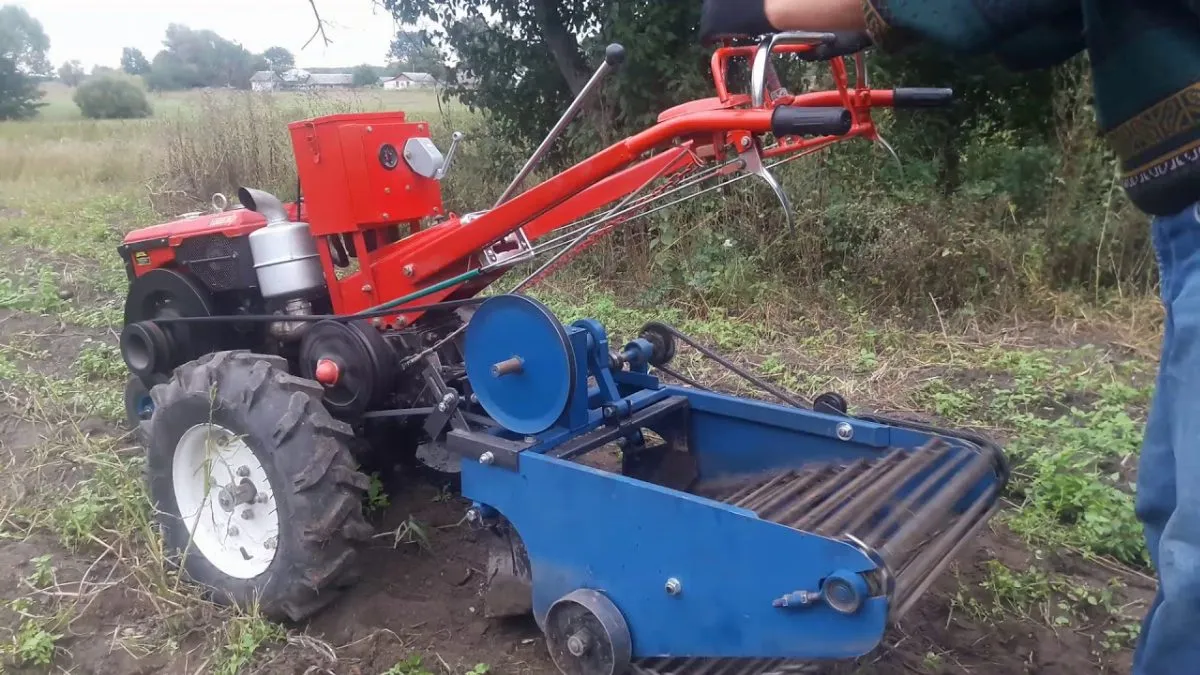
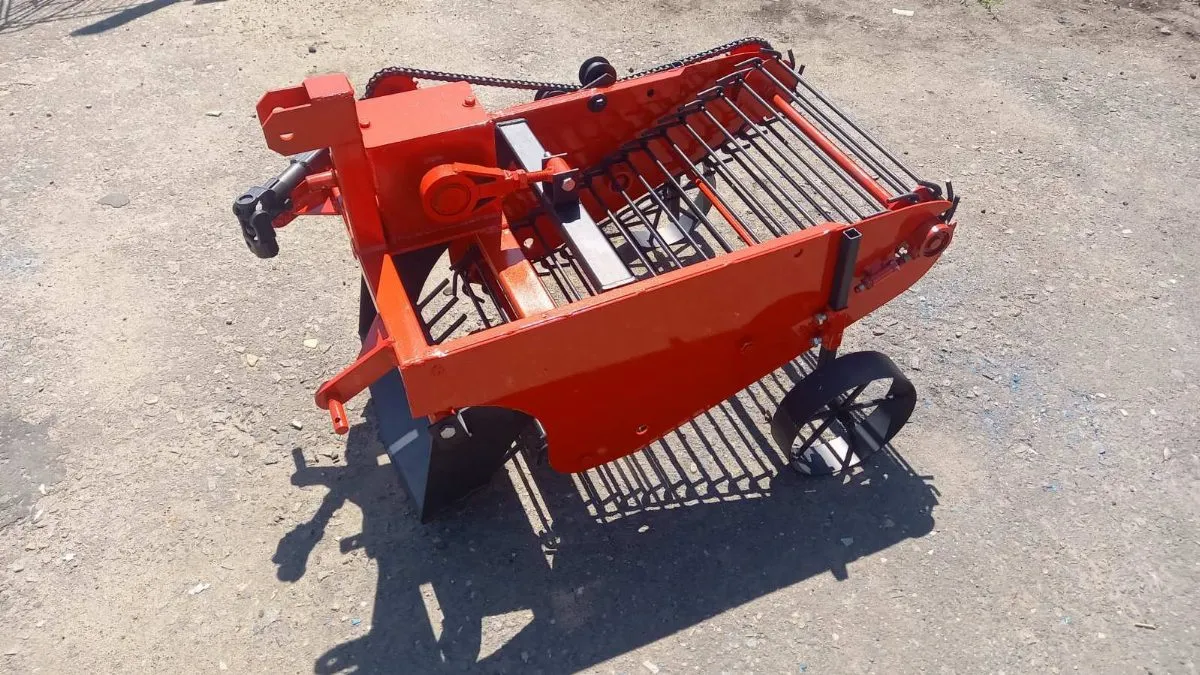
Shaker or vibration. Equipped with a grate that vibrates and sifts the soil. This significantly improves the quality of harvesting — the potatoes are cleaned and left on the surface. Losses are reduced to 5–8%. However, such models require sufficient power from the walk-behind tractor and proper setup. On heavy, damp soil, the efficiency of vibration can decrease if the equipment is weak.
Conveyor. They use a moving belt that carries the potatoes and separates the soil. This is the most productive option, used on plots of 30 ares and more. Such models work well on complex soils but are more expensive and require a powerful walk-behind tractor.
The type of soil directly affects the choice:
sandy — even simple models are suitable;
loam — shaker models are better;
damp heavy soil — conveyor or powerful vibration models.
A common mistake is buying "with a reserve." For example, an owner of 10 ares buys a conveyor model but does not use its potential and overloads the walk-behind tractor. As a result, costs are higher, and there is no real benefit.
If you compare the payback, for a plot of 10–15 ares, a simple digger pays off in 1–2 seasons, and a shaker one in 2–3. On large areas, vibration and conveyor models start saving time in the very first season.
Compatibility with the walk-behind tractor: what to look at first
Even the best potato digger will not work effectively if it does not fit the walk-behind tractor. Here it is important to consider not only the mount but also the actual operating parameters.
First is the hitch type. There are universal options, but branded mounts for specific models are common. Before buying, it is worth checking if the hitch is suitable or if an adapter will be required.
Second is power. Vibration models require a minimum of 6–7 hp, and 8–9 hp is better. If the walk-behind tractor is weaker, the vibration will be insufficient, and the soil will not be sifted. This is a common question from users: "why doesn't the digger shake?" The reason is usually exactly the power.
The weight of the equipment also plays a role. A digger that is too heavy can disturb the balance, and the walk-behind tractor will start to "dig in" or lose control.
Key points that are often missed:
depth adjustment — affects crop losses;
angle of attack — determines whether the digger will enter the ground or slide;
working width — must correspond to the capabilities of the walk-behind tractor.
Typical problems with incompatibility:
engine overload;
rapid wear of belts;
weak vibration in shaker models;
uneven work on the plot.
A practical way to check is to look at the walk-behind tractor manufacturer's recommendations or test the hitch at the store. If there are doubts, it is better to clarify the parameters: weight, required power, and connection type.
How to choose a potato digger for a walk-behind tractor: practical criteria
A rational choice begins not with the model, but with an analysis of the conditions. A mistake is to focus only on price or the advice of acquaintances without considering your own plot.
Evaluate the plot. It is important to consider not only the area but also the soil density, presence of stones, and humidity. A 10-are plot of light soil and a 10-are plot of loam are different tasks.
Choose the type of digger. For small plots — fan; for universal use — shaker; for large volumes — conveyor.
Check compatibility with the walk-behind tractor. This is a critical stage on which the result depends.
Key characteristics to look at:
working width — usually 30–45 cm;
processing depth — up to 20–25 cm;
productivity — from 0.05 to 0.2 hectares/hour;
material — metal thickness from 3 mm for working elements.
When inspecting, pay attention to the details:
smooth and strong weld seams;
structural rigidity;
quality of moving elements and fasteners;
presence of adjustments.
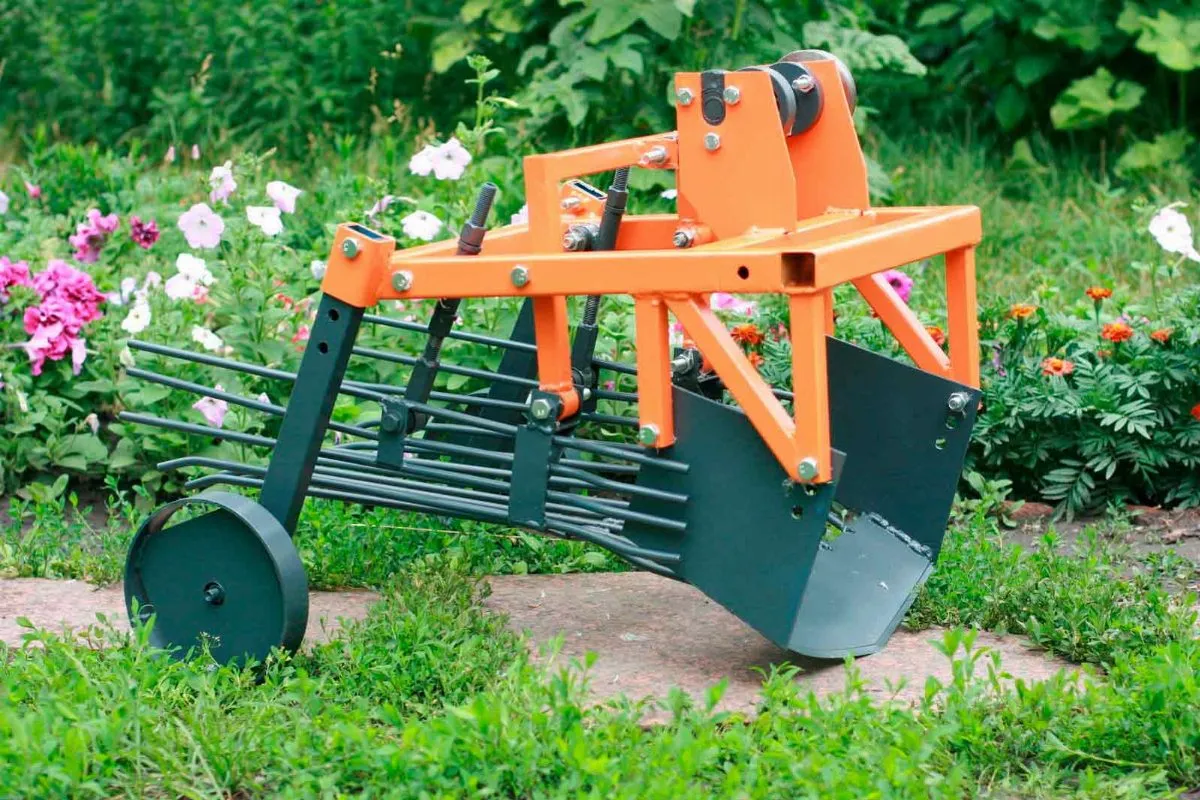
Adjustments are one of the most underestimated factors. Without them, even a good model can perform poorly. Cheap options often do not allow for precise adjustment of depth or angle, which leads to losses.
Examples:
10–15 are plot — a medium-power shaker model is optimal;
30+ are plot — a conveyor or reinforced vibration model is more profitable.
To avoid overpaying, it is important to ask yourself: will you use the model's capabilities? If not — it is better to choose a simpler, but high-quality and compatible solution.
Common mistakes during purchase and operation
Most problems arise not because of the equipment, but because of incorrect choice or use. This is confirmed by owner comments and service practice.
buying without considering the walk-behind tractor model — leads to incompatibility;
ignoring soil type — the digger cannot handle the load;
expecting a perfect result without adjustment — even expensive models require adjustment;
working on an unprepared plot — tops and stones reduce efficiency;
skimping on quality — cheap models break down faster.
Before first use, it is worth checking:
tightening of all fasteners;
depth and angle adjustment;
condition of belts and the hitch;
operation on a small section in test mode.
Competent choice and basic setup provide a noticeable difference in the very first season: fewer losses, faster harvesting, and lower load. If the walk-behind tractor is used not only for potato harvesting but also for soil preparation, you may additionally need a plow for a walk-behind tractor — it helps to process the soil qualitatively before planting and expands the machine's capabilities. This is exactly what makes a potato digger not just a purchase, but a working tool that really solves the task.
Editorial team agronom.info
Materials are prepared by the portal's agronomists and editors. We use only trusted sources: Ukrainian agricultural universities, variety registries, open scientific publications.
Related articles
Not yet comments. Be the first!
Comments