
Plough moldboards: why the problem with ploughing quality is often not in the field, but in the material
Learn why plough moldboards can reduce ploughing quality even with ideal settings, and how the material of the working parts determines a stable result.
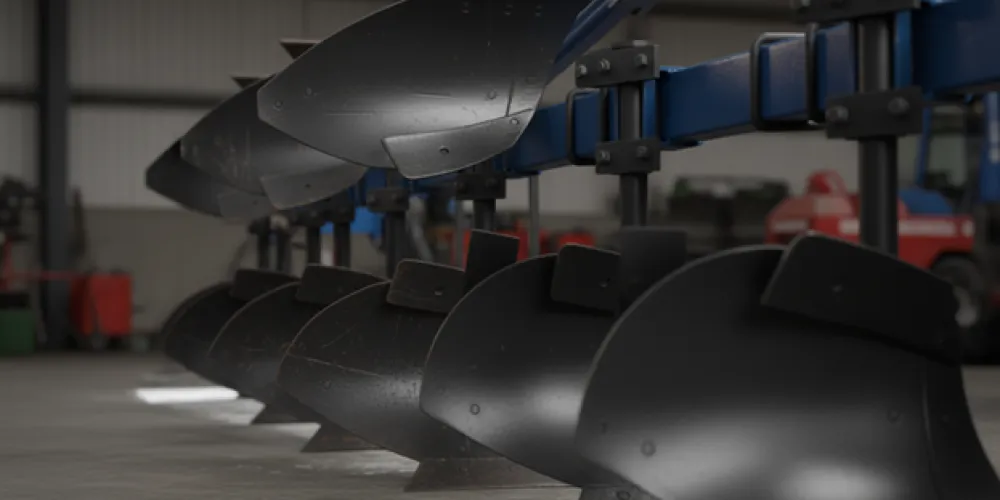
In practice, the same situation is often observed: ploughing quality is unstable, even though the machinery is in good condition and the settings have been adjusted correctly. In one pass, the result looks ideal; in another, deviations are already noticeable. In such cases, the cause is usually sought in the travel speed, the tractor, or the implement settings.
However, experience shows that the problem runs much deeper.
In many cases, the key factor is neither the machinery nor the field, but the material of the working parts. And above all, the plough moldboards. They are exactly what determine how the soil behaves during ploughing, and they are exactly what the stability of the result depends on.
The plough as a system, not a set of parts
One of the most common mistakes is to view the plough as a set of separate components. The share, the moldboard, the skimmer, the landsides — each element is often evaluated separately.
But a plough is an integrated system. All elements work in interconnection. Geometry, angles, surface shapes, and material form a single process of interaction with the soil. And if even one element works unstably, it affects the overall result.
Plough moldboards play a key role in this process. They do not simply turn over the furrow slice; they shape its movement:
- separation from the layer
- movement
- turning over
- placement
If this process is disrupted, unevenness appears even with correct settings. That is why ploughing quality is formed not in the field, but even before work begins — at the stage of plough configuration. And this is exactly where the material becomes a critically important factor.
Limitations of metal solutions
Metal has traditionally been the basic material for plough working parts. Under standard conditions, it demonstrates stable results. However, modern tillage conditions are much more complex.
Soil structure is changing, the number of heavy or waterlogged areas is increasing, and new agricultural technologies are emerging. Under such conditions, metal solutions begin to show their limitations.
The most typical problems are:
- soil sticking to the moldboard surface
- disruption of uniform turnover
- increased draft resistance
- accelerated wear
As a result, even with proper configuration and adjustment, ploughing with moldboards becomes unstable. A common solution is to replace worn elements with new ones. But in most cases, this does not solve the problem. The reason remains unchanged: the same material is used, with the same physical properties. In other words, the cycle repeats itself:
Material → Behavior → Problem → Replacement → The same result.
Plough moldboards and material: what composites change
At a certain point, it becomes obvious: for a stable result, it is not enough to change only the elements or the settings. The approach itself needs to be changed. And the key element of this approach is the material.
That is why farmers are increasingly paying attention to engineering composites. This is not a temporary solution and not an experiment, but a logical response to changing conditions.
A composite is a material whose properties are formed for a specific task. Its behavior is predictable and controllable. These characteristics fundamentally distinguish it from metal.
In practice, the use of composites in elements such as plough moldboards provides several important effects:
Reduced sticking
The surface interacts with the soil differently. The material does not retain wet soil, which reduces load and stabilizes the process.
More uniform operation
The furrow slice moves more predictably. Sudden changes in soil behavior disappear.
Geometric stability
Wear occurs more slowly, which allows the working part to retain its shape for longer.
Reduced load on machinery
Less resistance means lower energy consumption and less load on the implement.
One example of this approach is the use of materials based on TEKRONE plastic. This is an engineering composite developed specifically for agricultural conditions, where stable performance and minimising sticking are important. Such solutions are being actively developed by IQ Composite, a company focused specifically on materials for the agricultural sector.
It is important to understand that composite plough moldboards are not a replacement just for the sake of novelty. They are an adaptation of the system to real operating conditions.
A systematic approach to plough configuration
The transition to systems thinking changes the approach to plough configuration. The focus shifts from replacing a worn part to ensuring the stable operation of the system.
In this context, plough moldboards become one of the key points of influence. It is through them that the main interaction with the soil takes place. Accordingly, changing the material can affect:
- ploughing stability
- fuel consumption
- machinery load
- the wear rate of other elements
Practice shows that in a number of cases, changing the moldboard material has a more noticeable effect than adjusting the settings or even replacing the machinery.
This is explained simply: the material determines the nature of interaction with the environment.
Therefore, when choosing components, it is worth evaluating not only the shape and compatibility, but also the properties of the material.
The practical dimension: what this means for a farm
If we translate this into practical terms, changing the approach to material is not only about ploughing quality as such. It is about achieving a more predictable result under different conditions.
Modern farms do not operate in ideal scenarios. Fields differ, moisture changes, and soil structure is heterogeneous. Under such conditions, the key task is to achieve a stable result regardless of variable factors. This is exactly where the material begins to play the role of a system stabiliser.
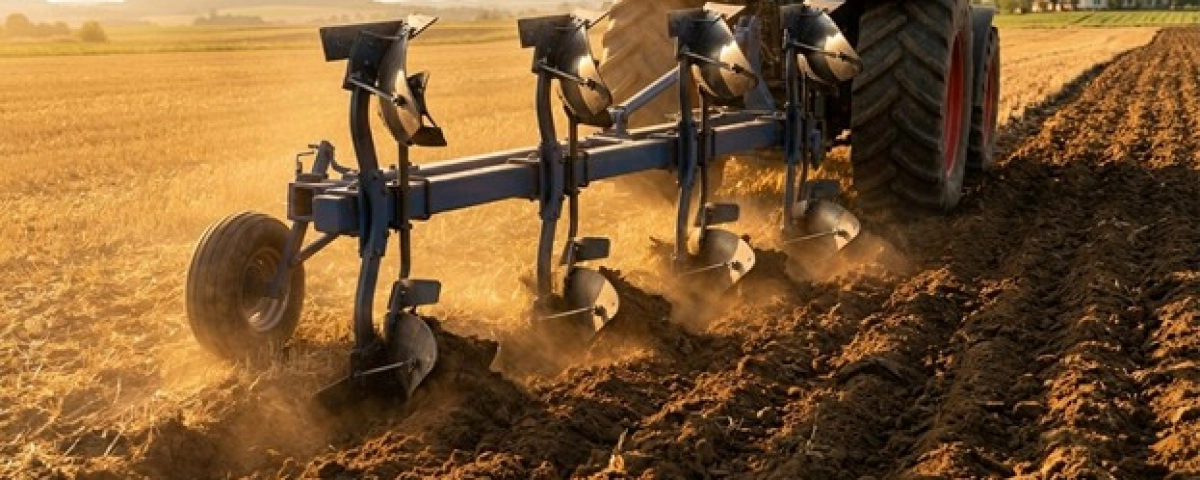
When plough moldboards work predictably:
- the number of repeated passes decreases
- dependence on ideal conditions is reduced
- it becomes easier to achieve the same quality across different parts of the field
This directly affects costs, both fuel and time. In addition, the long-term effect is also important. Less wear means not only less frequent replacement of parts, but also stable operation throughout the season. And this is critical during peak workload periods, when any downtime comes at a high cost.
As a result, the issue of material goes beyond a purely technical choice. It becomes a management decision. A decision about how stable, predictable, and economically efficient the system will be under real conditions.
Conclusion: where ploughing quality is formed
Ploughing quality is determined to a large extent not by field conditions and not by machine settings. It is established at the material level. And as long as the main focus remains only on speed, depth, or settings, the work is dealing with consequences rather than the cause.
The modern approach is to shift the point of focus: from settings to materials.
In this context, composite plough moldboards cease to be just a part. They become a key element that determines the efficiency of the entire system. And it is through them that the stability of the result is formed, which ultimately affects the economics of ploughing.
Editorial team agronom.info
Materials are prepared by the portal's agronomists and editors. We use only trusted sources: Ukrainian agricultural universities, variety registries, open scientific publications.
Related articles

Not yet comments. Be the first!
Comments