

Description
How to tell it apart
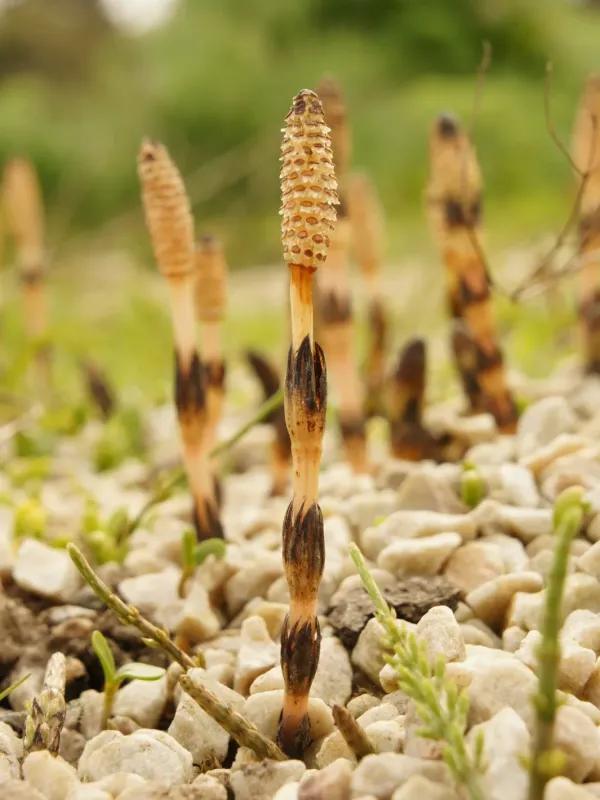
Field horsetail (Equisetum arvense) is a perennial, spore-bearing plant belonging to the Equisetaceae family. It exhibits distinct seasonal dimorphism: fertile, non-photosynthetic brown shoots emerge in spring, followed by sterile, green, jointed vegetative stems in summer.
The plant lacks true leaves; instead, it features scale-like sheaths arranged in whorls at the nodes. The stems have a rough texture due to high silica content in the tissues, which grants the plant remarkable resistance to physical damage and environmental stressors.
The root system is the plant's primary survival mechanism. It consists of a robust, creeping rhizome that can penetrate the soil up to one meter deep. These rhizomes store significant energy reserves in specialized tubers, enabling the plant to resprout even after severe damage.
Spores are produced in small, cone-like structures on fertile stems, but the primary method of spread in agricultural environments is through the aggressive vegetative expansion of the underground rhizome network.
As an indicator species, the presence of field horsetail in abundance typically signals acidic, poorly drained, or compacted soil conditions, identifying it as a weed that flourishes where traditional drainage management is lacking.
Where it grows
Field horsetail is widely distributed across temperate agricultural regions. It is a common inhabitant of cultivated fields, pastures, roadsides, and riverbanks, demonstrating high adaptability to various moisture levels and soil compositions.
It poses a significant threat to cereal crops, row crops, and vegetable production. The weed favors heavy clay or loam soils where moisture retention is high, making it particularly troublesome in poorly drained low-lying areas of a farm.
In managed agricultural systems, the species exploits disturbances in the soil profile. Its ability to grow from deep root fragments allows it to quickly colonize fields following traditional tillage practices, often outcompeting less aggressive native flora.
The weed is highly resilient to temperature fluctuations, ensuring its survival across diverse growing seasons. Its adaptability makes it a persistent nuisance that can survive even in high-input farming systems if soil conditions remain favorable.
In addition to agricultural fields, it is frequently found in meadows and disturbed sites, which serve as reservoirs for re-infestation of nearby arable lands through the mechanical spread of rhizome segments by equipment.
Harm it causes
The primary harm caused by field horsetail is its extreme persistence. Because of its deep-seated rhizome network, traditional weeding methods often fail, as leaving even small root segments in the soil leads to rapid regeneration and re-infestation.
The weed competes aggressively for water and essential soil nutrients, often drawing these resources from depths unreachable by many crop roots. This competitive pressure leads to significant yield losses, particularly in seasons with limited water availability.
Furthermore, field horsetail creates dense stands that reduce soil aeration and heat absorption. This microenvironment can hinder the germination and early development of cultural crops, creating uneven stands and increasing susceptibility to secondary pests.
The plant contains alkaloids that are toxic to livestock, particularly horses and cattle, if ingested in large quantities or mixed into hay. This lowers the quality and safety of forage harvested from infested lands, posing an economic risk.
- Severe competition for water and nutrients.
- Potential toxicity to livestock in harvested hay.
- Increased labor and material costs for weed management.
- Interference with crop establishment and growth.
How to control
Agronomic control must start with soil testing and lime application to reduce soil acidity. Increasing the pH level creates a less favorable environment for the weed, gradually reducing its vigor and competitive advantage within the field.
Improving field drainage is a critical component of long-term management. By addressing waterlogging, farmers can make the environment unsuitable for horsetail, allowing crops to regain their competitive edge and reducing weed spread.
Mechanical control focuses on the depletion of rhizome energy reserves. Regular deep tillage combined with systematic cultivation brings rhizomes to the surface, where exposure to sunlight and drying can cause the death of plant tissue.
Chemical control is challenging due to the plant's waxy, silica-rich surface and resilient root system. Effective herbicide programs require systemic products applied at specific developmental stages to maximize translocation into the rhizomes.
An integrated approach is essential for success. Combining chemical strategies with improved drainage, soil amendment, and competitive crop rotation schedules is the only way to manage and eventually suppress field horsetail in professional agricultural operations.
Content graph
Connections · Field horsetail
Most often together:
Marketplace
Products · 3


Biology
Taxonomy
- Latin name
- Equisetum arvense
- Family
- Болотные сорняки