

Yellow foxtail
Setaria pumila
Description
How to tell it apart
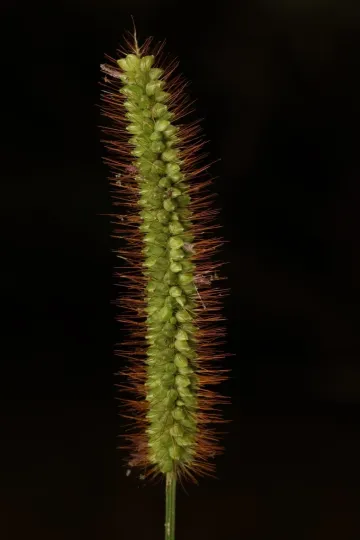
Yellow foxtail (Setaria pumila) is a summer annual grass weed belonging to the Poaceae family. Its most distinctive feature is its cylindrical, spike-like panicle, which is covered with stiff, yellow-golden bristles that resemble a fox's tail.
The stems can reach a height of 20 to 80 centimeters and often branch at the base. The leaves are flat, narrow, and often have a bluish-green tint with long, distinct hairs at the leaf base, which helps distinguish it from other foxtail species.
Its root system is fibrous and robust, allowing the plant to anchor firmly in various soil types. The plant reproduces via seeds, which are produced in large numbers and can remain viable in the soil seed bank for several years.
As a warm-season grass, yellow foxtail typically germinates in late spring or early summer when soil temperatures reach 10–12°C. It thrives in high-light environments and is highly adaptable to various ecological conditions.
The plant's morphological structure allows it to withstand moderate trampling and various agricultural field conditions, making it a persistent competitor in cultivated fields.
Where it grows
Yellow foxtail is widely distributed globally, particularly in temperate and subtropical climates. It is frequently found in agricultural fields, pastures, gardens, and along roadsides, showing a strong preference for fertile soils.
It is a significant pest in row crops, including corn, soybeans, and sunflowers. Because it grows during the same period as these crops, it directly competes for available sunlight, water, and essential soil nutrients.
The weed is highly tolerant of various soil conditions, including heavy or compacted soils, which allows it to establish itself in areas where other species might struggle. Its ability to tolerate low nutrient levels further extends its range.
Field margins and areas with poor ground cover are particularly susceptible to yellow foxtail infestation. Once established, it can quickly colonize empty spaces through seed dissemination by wind, water, or machinery.
Continuous cropping systems without rotation or proper weed management often see an increase in yellow foxtail populations, as the weed easily adapts to recurring tillage and herbicide programs.
Harm it causes
The primary harm caused by yellow foxtail is severe resource competition. By rapidly developing its biomass, the weed shades out crop seedlings and depletes soil moisture and nitrogen, leading to significant yield losses in row crops.
Beyond resource competition, yellow foxtail acts as an alternative host for various plant viruses and insect pests. These pathogens can easily transfer to neighboring cash crops, exacerbating existing plant health issues.
Harvesting efficiency is often reduced in heavily infested fields. The presence of dense weed foliage adds moisture to the harvested material, necessitating higher energy consumption for drying and increasing the risk of grain spoilage during storage.
In hay production, yellow foxtail reduces forage quality. The stiff bristles of the inflorescence can cause physical injury to the mouths and digestive tracts of livestock, leading to feed refusal or health complications in cattle.
The sheer volume of seeds produced by a single plant ensures that a field can remain infested for years, imposing long-term economic burdens on farmers who must invest in persistent control measures.
How to control
Effective control of yellow foxtail requires an integrated approach. Cultural practices such as crop rotation, use of competitive cover crops, and proper row spacing can help suppress weed emergence by minimizing the light available to germinating seeds.
Tillage practices, specifically timely shallow cultivation, can kill young seedlings before they establish deep roots. Pre-plant tillage is essential for clearing the field of early flushes of the weed.
Chemical control remains a vital component, particularly through the use of post-emergence graminicides. It is critical to apply these herbicides during the early growth stages of the weed, specifically when it is in the 2- to 4-leaf stage.
Proper timing of herbicide application ensures maximum efficacy, as the plant becomes significantly more resistant to chemical intervention as it matures and approaches the heading stage.
- Utilize crop rotation with dense canopy crops.
- Implement timely post-emergence herbicide applications.
- Maintain proper soil fertility management.
- Conduct mechanical cultivation in row crops.
Content graph
Connections · Yellow foxtail
Most often together:
Marketplace
Products · 420

Melon, KS (nicosulfuron, 40 g/l)
«Нанджин Ессенс Файн-Кемікал Ко. Лтд» (Китай)
Herbicides
0
0
·
45
3 offers
35 110 €per 1000 pcs
Buy

Tiran, WG, herbicide
Innovative company 'Agro Protection', LLC
Herbicides
0
0
·
45
7 offers
39.57 €per 1 l
Buy

Sulfonyl, VG, (Nicosulfuron, 750 g
Ф.Шаньдонг Цяочанг Кемікал Ко. Лтд.Китай.
Herbicides
0
0
·
45
3 offers
61.89 €per 1 l
Buy

Toplanz 240 EC
Фадер Альянс Лтд., Великобританія (Fader Alliance Ltd., England) на заводах Нідерландів, Польщі
Herbicides
0
0
·
44
3 offers
12.66 €per 1 l
Buy


Centurion k.e. herbicide with surfactant 'Amigo'
Аріста ЛайфСайенс С.А.С., Ногер, Франція
Herbicides
0
0
·
44
4 offers
137 €per 1 l
Buy


Britex 40, RK
Фадер Альянс Лтд., Великобританія (Fader Alliance Ltd., England) на заводах Нідерландів, Польщі
Herbicides
0
0
·
42
1 offer
15.53 €per 1 l
Buy


ANTILIONA, KE, (Klethiom, 360 g/L)
Shandong Weifang Rainbow
Herbicides
0
0
·
41
1 offer
22.63 €per 1 l
Buy


Serp, w.r.k., (imazethapyr, 100 g/l)
Peters & Burg Kft.
Herbicides
0
0
·
40
1 offer
8.9 €per 1 l
Buy


Legend, MD (mesotrione, 75 g/l +nicosulfuron, 30 g/l)
Peters & Burg Kft.
Herbicides
0
0
·
39
4 offers
11.95 €per 1 l
Buy


Basis 75 WG
«Дюпон Інтернешнл Оперейшнз Сарл», Швейцарія
Herbicides
0
0
·
39
1 offer
764.25 €per 1 l
Buy


Tivitus, WG ( rimsulfuron, 250 g/kg)
ТОВ «Фабрика агрохімікатів», Черкаси, Україна
Herbicides
0
0
·
37
1 offer
15.46 €per 1 l
Buy


Fusilade Forte 150 EC c.e.
Сингента Лімітед, Хаддерсфільд,Великоб-ританія
Herbicides
0
0
·
37
7 offers
19.83 €per 1 l
Buy

Cruise w.g., Herbicide with Surfactant "Flox" (Rimsulfuron 250 g/kg) (
China Chemical Industrial & Rice Co. Ltd
Herbicides
0
0
·
37
1 offer
23.28 €per 1 l
Buy

AGROACETOXCHLOR, K.E., HERBICIDE (ACETOXCHLOR, 900 G/L)
Ф.Шаньдонг Цяочанг Кемікал Ко. Лтд.Китай.
Herbicides
0
0
·
37
1 offer
5.07 €per 1 l
Buy


Starra, CE (Hizalofop-P-ethyl, 50 g/l)
ДДЕ Фарм АГ, Тризен, Ліхтенштейн
Herbicides
0
0
·
36
1 offer
812.51 €per pack
Buy

Quin Star Max
ТОВ «Фабрика агрохімікатів», Черкаси, Україна
Herbicides
0
0
·
36
12 offers
7.41 €per 1 l
Buy


MILACOS, K.S., (NICOSULFURON, 40 G/L)
Jiangsu Qiaoji Biochem
Herbicides
0
0
·
36
4 offers
2.96 €per 1 l
Buy


ALPHA-NUFURON, WG
“Зібо Наб Агрокемікалс Лімітед“, Китай
Herbicides
0
0
·
36
1 offer
86.94 €per 1 l
Buy


HERBONIK
ТОВ «Фабрика агрохімікатів», Черкаси, Україна
Herbicides
0
0
·
35
3 offers
34.4 €per 1 l
Buy
Antelope, KE (clethodim, 360 g/l)
Shandong Weifang Rainbow
Herbicides
0
0
·
34
1 offer
22.63 €per 1 l
Buy


HIZALAFOP-STAR
ТОВ «Фабрика агрохімікатів», Черкаси, Україна
Herbicides
0
0
·
34
1 offer
10.64 €per 1 l
Buy

Tron, WG ( rimsulfuron, 250 g/kg)
Jiangsu Institute of Ecomones Co., Ltd.
Herbicides
0
0
·
33
1 offer
61.62 €per 1 l
Buy


Biology
Taxonomy
- Latin name
- Setaria pumila
- Family
- Однолетние злаковые