

Description
How to tell it apart
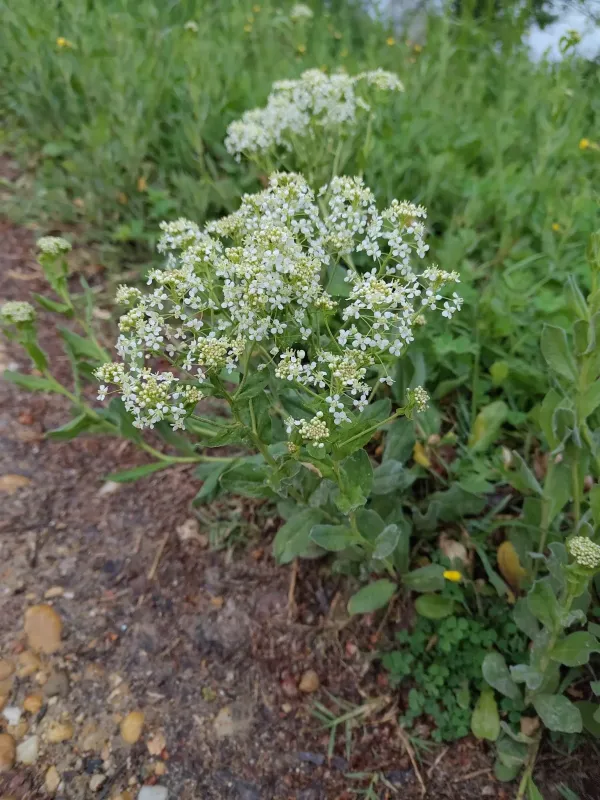
Hoary cress (Lepidium draba) is a persistent perennial weed belonging to the Brassicaceae family. It is recognized by its deep taproot and aggressive ability to spread via underground rhizomes.
The plant grows between 20 and 60 cm in height. Its leaves are blue-green, with the upper leaves clasping the stem, giving the plant a distinctive appearance during the growing season.
In late spring, the plant produces clusters of small, four-petaled white flowers that create a conspicuous, dense canopy over infested areas.
Its fruits are heart-shaped, two-seeded pods that turn brown upon maturation. These seeds are easily dispersed by wind, water, and agricultural equipment, aiding in rapid colonization.
The root system is the defining characteristic of this weed. It consists of vertical taproots and lateral shoots that can extend several meters, making mechanical extraction nearly impossible.
Where it grows
Hoary cress is commonly found in disturbed sites, such as agricultural fields, roadsides, irrigation ditches, and abandoned farmland. It thrives in various soil types, particularly clay and alkaline soils.
The weed is highly drought-tolerant, allowing it to dominate areas where other crops might struggle due to moisture stress. Its ability to extract water from deep soil layers gives it a competitive edge.
It is particularly problematic in winter grain crops. As a winter-active perennial, it begins its growth cycle early in the spring, preempting the development of seasonal row crops.
The plant prefers open, full-sun environments. However, it exhibits a high degree of phenotypic plasticity, adapting to both disturbed landscapes and minimally managed pastures.
Once established, hoary cress populations tend to expand into circular patches, which steadily increase in diameter each year, forming monocultures that effectively exclude native or desired vegetation.
Harm it causes
The primary harm caused by hoary cress is its severe competition with crops for nitrogen, phosphorus, and soil moisture. Its deep root system essentially mines resources away from shorter-rooted crops.
The dense above-ground foliage shades out seedling crops, inhibiting photosynthesis and leading to stunted crop growth and reduced biomass yield during harvest.
Hoary cress acts as an alternate host for several plant viruses and pests. It creates a breeding ground for insects that can then migrate into valuable nearby crops, increasing pest management costs.
The presence of this weed significantly lowers land value and productivity. In agricultural settings, it complicates harvest operations and may lead to dockage in grain due to contaminated seed samples.
It is classified as an invasive species in many regions because it disrupts local ecosystem biodiversity and requires intensive, long-term management efforts to contain.
How to control
Mechanical control involves persistent tillage. Deep plowing helps to sever the lateral root connections, though this must be repeated multiple times to exhaust the root reserves completely.
Cultural methods include the use of competitive cover crops. Establishing dense stands of forage crops can suppress the emergence of hoary cress by limiting the light reaching the soil surface.
Chemical control is most effective using systemic herbicides. Products containing glyphosate, 2,4-D, or specific sulfonylureas, when applied at the rosette stage, offer the best suppression rates.
Timing is critical for chemical management. Applications should be made when the plant is in the rosette to early budding stage, before the flower spikes emerge and the plant shifts energy to seed production.
Integrated Weed Management (IWM) programs are necessary for long-term success. Combining herbicide rotations, crop competition, and strategic cultivation prevents the development of resistant weed biotypes.
Content graph
Connections · Hoary cress
Most often together:
Marketplace
Products · 1
Biology
Taxonomy
- Latin name
- Lepidium draba
- Family
- Многолетние корнепаростковые