

Description
How to tell it apart
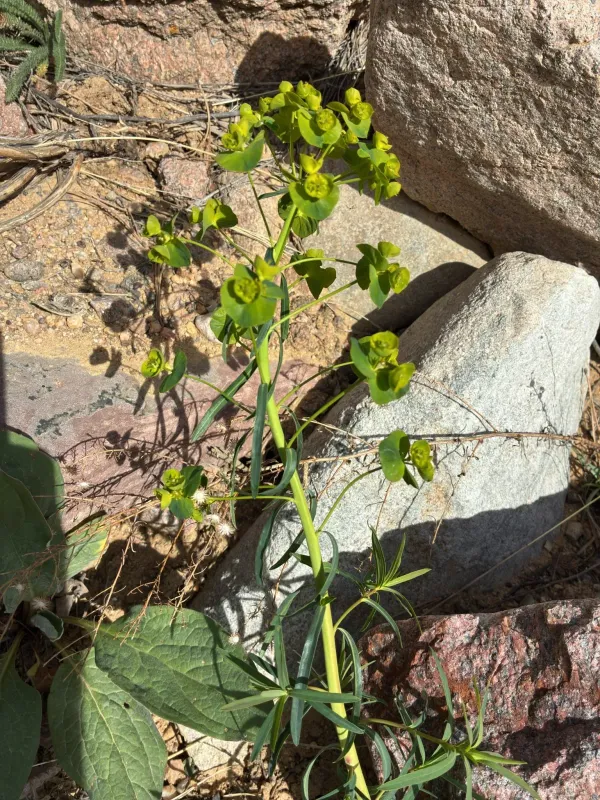
Leafy spurge (Euphorbia virgata) is a perennial herbaceous plant belonging to the Euphorbiaceae family. It is characterized by an extensive, deep-reaching root system that can extend several meters underground and produce new shoots from adventitious buds.
The stems are erect, reaching heights between 40 and 80 cm, and are densely covered with narrow, lanceolate leaves. A hallmark of this species is the milky latex sap it exudes when the stem or leaves are broken, which is toxic to livestock.
The leaves are linear, alternate, and sessile, often with a smooth, entire margin. The plant produces yellowish-green floral bracts arranged in complex umbels, which bloom from late spring through the mid-summer months.
As a prolific seed producer, leafy spurge develops three-lobed capsules. When these ripen, they dry and explosively dehisce, scattering seeds up to several meters away, which facilitates rapid colonization of new patches.
This weed is highly resilient due to its complex root system. Even tiny root segments left in the soil during cultivation can regenerate, making mechanical removal extremely difficult without systemic treatments.
Where it grows
Leafy spurge is widely distributed across temperate regions of Eurasia and has become an invasive concern in various agricultural settings. It thrives in open, sunny environments including pastures, meadows, and neglected fields.
In cropping systems, it is a significant weed in cereals and broad-leaved crops. It prefers disturbed areas, roadsides, and the edges of irrigation ditches, where it establishes stable, long-term colonies.
It is remarkably tolerant of various soil conditions, including dry, sandy, or rocky terrains. This versatility allows it to outcompete native or crop species in areas where moisture and nutrient levels are fluctuating.
The weed frequently exploits field borders and uncultivated corners of the farm. From these reservoirs, it gradually spreads into the main production fields, often unnoticed until a large patch is established.
Irrigation canals serve as primary conduits for seed dispersal, spreading the weed downstream to downstream farms and new agricultural plots, often leading to rapid infestation across large landscape areas.
Harm it causes
The primary impact of leafy spurge is its intense competition for limited resources. Its deep roots allow it to extract water and nutrients from soil layers that are inaccessible to many shallow-rooted crops.
The plant exhibits strong allelopathy, releasing chemicals from its roots that inhibit the growth and germination of surrounding crops, leading to significantly lower yields and sparse crop stands.
Because of its toxic latex, it poses a direct threat to livestock. If infested forage is harvested and fed to cattle or sheep, it can cause severe internal toxicity, digestive distress, and potential mortality.
Infestations increase the cost of agricultural production. Farmers must spend extra resources on seed cleaning, sorting, and increased herbicide applications to prevent the spread of the weed throughout their fields.
Large patches of leafy spurge impede the efficiency of machinery. Increased biomass and deep roots require more power for tillage and can clog harvesting equipment, leading to higher fuel and maintenance costs.
How to control
Controlling leafy spurge requires a multi-year strategy. Deep tillage can help weaken the root system over time, but it must be performed repeatedly and is most effective when combined with other management practices.
Integrated pest management (IPM) is essential. Crop rotation helps disrupt the growth cycle of the weed, while competitive, fast-growing cover crops can shade out spurge seedlings and slow their establishment.
Chemical control is most effective when systemic herbicides are applied. Products containing glyphosate or specific growth-regulator herbicides are often used on post-harvest regrowth to ensure the chemical reaches the root system.
Because of the weed's ability to regenerate from roots, a single application is rarely sufficient. A consistent, long-term monitoring and re-treatment program is necessary to keep the infestation under control.
- Deep cultivation to exhaust root reserves.
- Systemic herbicide application during the active growth phase.
- Use of competitive cover crops to suppress seedling growth.
- Strict monitoring of field edges and irrigation channels.
- Prevention of seed maturation through timely mowing or grazing.
Content graph
Connections · Leafy spurge
Most often together:
Marketplace
Products · 1
Biology
Taxonomy
- Latin name
- Euphorbia virgata
- Family
- Многолетние корнепаростковые