

Tomigan 250
F.A.GAN Chemical Manufacturers Ltd. Israel, member
Herbicides
0
0
·
1.6K
6 offers
20.04 €per 1 l
Buy
Cuscuta campestris
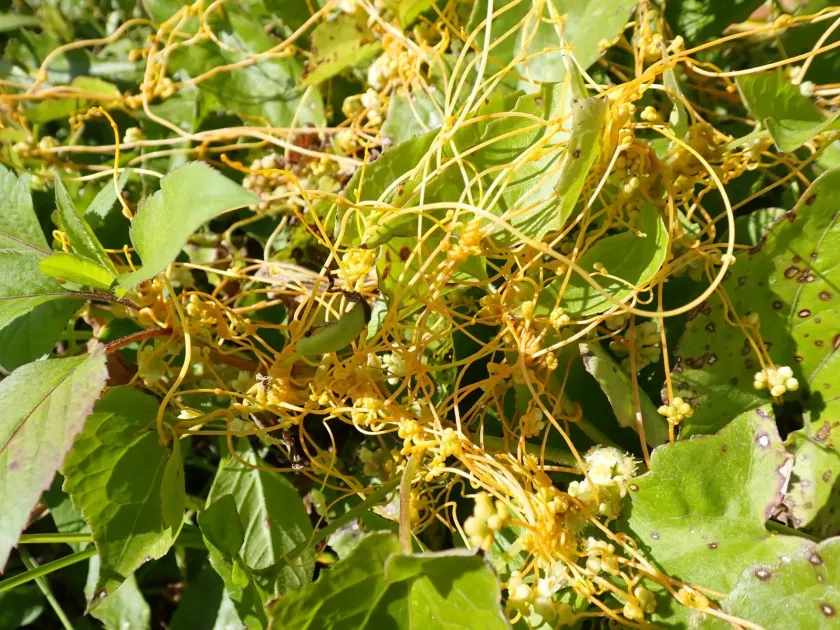
Field dodder (Cuscuta campestris) is an annual parasitic plant belonging to the Convolvulaceae family. It is characterized by the complete absence of roots and true leaves, appearing as a network of slender, yellowish to orange thread-like stems.
The plant attaches itself to host plants using specialized organs called haustoria. These structures penetrate the tissues of the host, extracting water, nutrients, and carbohydrates directly from the xylem and phloem.
It produces small, white or greenish-white flowers clustered in dense heads. The flowering period is prolonged, allowing for a steady production of seeds that can survive in the soil for many years.
Dodder is easily recognizable in fields as it forms dense, web-like mats that overgrow crops. Affected areas often show stunted growth, chlorosis, and, in severe cases, the complete death of the host plant.
Because it lacks chlorophyll, the plant is entirely dependent on its host, making it a highly aggressive invasive species that can rapidly colonize entire fields if left unchecked.
Field dodder is a versatile parasite that affects a wide variety of crops, including alfalfa, clover, soybeans, potatoes, sugar beets, and various vegetables. It also parasitizes many wild herbaceous plants and shrubs.
It prefers sunny, warm environments but is capable of thriving in diverse conditions. It is commonly found in agricultural fields, along roadsides, near irrigation ditches, and in neglected meadows, which serve as reservoirs for future infestations.
Dissemination occurs primarily through contaminated seed lots, but the seeds are also easily transported by wind, water runoff, and agricultural machinery. Animals can also spread the seeds through their fur or manure.
The seeds have a hard seed coat, allowing them to remain dormant in the soil for up to a decade. They germinate in response to warmth and moisture, often triggered by the presence of a nearby host plant.
Intensive farming practices without adequate crop rotation or sanitation measures facilitate the buildup of dodder seed banks, making it a persistent and difficult weed to eradicate once it establishes a foothold.
The primary impact of field dodder is the depletion of the host plant. By siphoning off resources, it significantly reduces the host's ability to perform photosynthesis, leading to weakened plants and dramatic reductions in yields.
Dodder-infested plants are significantly less resistant to environmental stressors such as drought and extreme temperatures. They are also more susceptible to secondary infections by fungi and bacteria.
Crucially, field dodder acts as an efficient vector for plant viruses. It can transmit dozens of viral diseases by forming physical bridges between infected and healthy plants, causing devastating outbreaks across entire fields.
In addition to agricultural yield losses, dodder presence affects the quality of harvested products. Seeds mixed with grain or hay can lead to quarantine restrictions, lowering market value and potentially causing toxicity in livestock consuming contaminated fodder.
Managing dodder infestations requires significant time and financial investment, including crop destruction, quarantine measures, and intensive monitoring, which adds to the overall economic burden on producers.
Effective control relies on an integrated pest management (IPM) approach. This begins with the use of clean, certified seeds and strict quarantine of agricultural machinery that may have been used on infested sites.
Crop rotation is one of the most successful preventive measures. Planting non-host crops, such as most grasses or cereals, deprives the dodder of a host, eventually reducing the seed bank in the soil.
Physical removal or spot-burning of infested areas is necessary as soon as dodder is detected. This prevents the weed from producing seeds and spreading throughout the rest of the crop field.
Chemical control is challenging because the parasite is attached to the host. Post-emergence herbicides that are selective are rarely effective; therefore, localized application of non-selective herbicides to both host and parasite is common practice.
