

Description
How to tell it apart
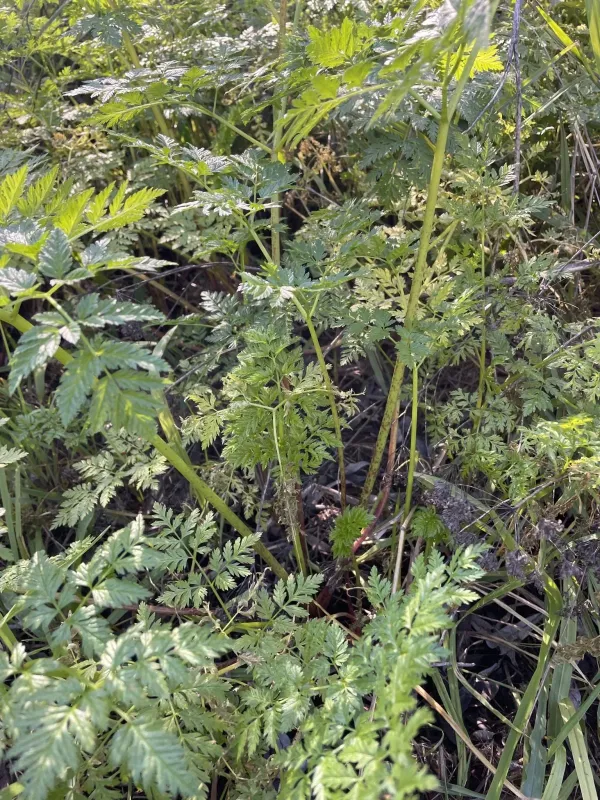
Poison hemlock (Conium maculatum) is a biennial herbaceous plant belonging to the Apiaceae family. It develops as a basal rosette in its first year and produces a tall, branched stem in its second year.
The plant is easily identified by its smooth, hollow stems marked with purple blotches. The leaves are fern-like and finely divided, emitting a strong, unpleasant musty odor when crushed.
It features a taproot that is whitish and fleshy, resembling a parsnip. The flowers are small, white, and organized into compound umbels, which is typical for the carrot family.
Seeds are produced in large quantities and are easily dispersed by wind, water, and farm equipment. They can remain viable in the soil for several years, making long-term control difficult.
All parts of the plant, especially the seeds, contain potent alkaloids. It is highly poisonous to both humans and livestock, necessitating careful handling and personal protection.
Where it grows
Poison hemlock thrives in moist, nitrogen-rich soils. It is frequently found in waste areas, along roadsides, near ditches, in pastures, and along the edges of agricultural fields.
In agricultural settings, it often colonizes riparian areas and poorly managed field margins. From these reservoirs, seeds can easily spread into cultivated land if not controlled.
The plant is highly adaptable and can grow in various environments, from full sun to partial shade. It is particularly invasive in disturbed soils where native vegetation has been removed.
Because it establishes easily in neglected areas, it is often seen around barns, fences, and irrigation structures where regular mechanical cultivation is absent.
Its presence in an agro-landscape is often a sign of poor weed management on non-cropped areas, acting as a source of re-infestation for the entire farm.
Harm it causes
The primary concern with poison hemlock is its toxicity. If ingested by livestock through hay or grazing, it causes severe respiratory distress and can be fatal to cattle, sheep, and horses.
As a weed, it competes with crops for water and nutrients. Its rapid growth and large stature allow it to shade out smaller plants, reducing yield in infested areas.
It can act as a host for pests and diseases that affect commercial vegetable crops, specifically those in the Apiaceae family like carrots, celery, and parsley.
The presence of dense hemlock stands interferes with harvesting operations. The stems can clog mechanical equipment, slowing down field productivity and increasing maintenance requirements.
In grazing lands, the weed makes areas inaccessible to livestock, effectively reducing the available forage area. This loss of land productivity can be significant over large farms.
How to control
Effective control requires a combination of mechanical and chemical approaches. Deep tillage before the plant enters its second year of growth is highly effective at killing the rosettes.
Mowing the plants before they set seed is critical to preventing the next generation. However, because the plant is toxic, protective gear must be worn to prevent skin irritation or accidental ingestion.
Herbicides such as glyphosate are effective for spot treatment in non-crop areas. For broad-spectrum control in pastures, selective growth-regulator herbicides can be applied.
Timing is the most important factor in chemical control. Herbicides work best when applied while the plant is in the rosette stage or early bolting stage before flowers bloom.
- Regular inspection of fence lines and ditches.
- Manual removal of plants, ensuring the root is pulled up.
- Maintaining competitive forage cover in pastures.
- Applying herbicides according to label guidelines for efficacy and safety.
Content graph
Connections · Poison hemlock
Most often together:
Marketplace
Products · 1
Biology
Taxonomy
- Latin name
- Conium maculatum
- Family
- Ядовитая растительность