
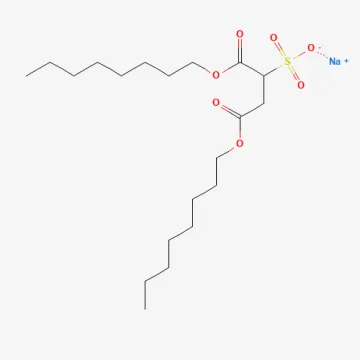
Sodium dioctyl sulfosuccinate
Description
Mode of action
Sodium dioctyl sulfosuccinate is a powerful anionic surfactant widely used in agrochemistry as a functional component for plant protection product formulations.
The core physical and chemical mechanism involves a significant reduction of the surface tension of aqueous solutions. This prevents spray droplets from bouncing off leaf surfaces and promotes immediate spreading, thereby increasing the contact area.
Due to its chemical structure, the substance modifies the permeability of the leaf cuticle, facilitating the penetration of active pesticide ingredients into plant tissues. It also helps overcome hydrophobic barriers, such as waxy coatings found on many weeds.
Within multi-component mixtures, sodium dioctyl sulfosuccinate serves as a dispersant and emulsifier, ensuring the stability of the spray solution and preventing the separation of active ingredients during storage in the sprayer tank.
This compound enhances the biological efficacy of systemic preparations by shortening the time required for active ingredients to be absorbed, making treatments less dependent on weather conditions following application.
What it targets
Sodium dioctyl sulfosuccinate is not an active ingredient against specific pests or diseases; rather, it is classified as an auxiliary adjuvant designed to improve the performance of herbicides, fungicides, and insecticides.
Using this component is highly recommended when dealing with hard-to-control weeds that possess dense trichomes or thick waxy cuticles, which are typically poorly wetted by standard solutions.
The substance is effective in tank mixtures for controlling pests with dense chitinous covers, as it improves coverage of the plant surface and helps the preparation reach insect habitats.
In fungal protection, the adjuvant promotes a more uniform distribution of the product across the leaf blade, which is critical for contact fungicides that act exclusively at the site of application.
The use of this surfactant allows for the optimization of pesticide consumption, reducing wastage caused by the runoff of the solution from the leaves to the soil.
Restrictions
Despite its high efficacy, it is essential to strictly follow the manufacturer's recommendations regarding the compatibility of sodium dioctyl sulfosuccinate with other components in a tank mixture.
Water hardness is a key limitation; when preparing the solution, one must account for the fact that overly hard water can reduce the activity of anionic surfactants, making the use of water conditioners advisable.
The handling of the product requires adherence to personal protective equipment protocols, as concentrated solutions can cause irritation to skin and mucous membranes if handled improperly.
Care must be taken to prevent the concentrate from entering open bodies of water, as it is a surfactant that can negatively impact aquatic organisms.
Before large-scale application, a phytotoxicity test should be conducted on a small area, especially when working with sensitive crops under stressful environmental conditions such as drought or low temperatures.
Status in the European Union
Not approved in the EU
- CAS number
- 1639-66-3
- Category (EU)
- AC - Acaricide
EU status is for reference only and does not replace national registration in your country.