
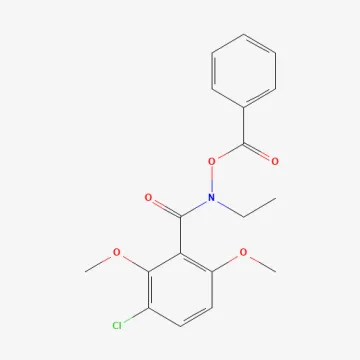
Benzoximate
Description
Mode of action
Benzoximate is a contact acaricide belonging to the benzoyl-oxime chemical class. It is a highly specialized active ingredient that affects pests by disrupting their physiological processes upon contact with the treated surface.
The substance is characterized by significant ovicidal and larvicidal activity. It is capable of interrupting the development of pests at early stages by affecting eggs and larvae, which is critical for preventing mass outbreaks of mite populations in agrocenoses.
The mode of action of benzoximate is aimed at suppressing vital enzymatic systems of the pest. Unlike systemic agents, it acts primarily through contact, so the quality of leaf surface coverage with the spray solution is a critical factor for effectiveness.
This compound demonstrates a long duration of protective action. After application, benzoximate is resistant to wash-off by precipitation, ensuring stable performance of the product even under variable weather conditions and high humidity.
The product does not possess systemic activity within the plant and does not move through the vascular system. However, its high lipophilicity allows the substance to remain in the waxy layer of the leaves, maintaining activity against mobile stages of mites for an extended period.
What it targets
The primary purpose of benzoximate is to combat various species of phytophagous mites. It is most effective against members of the Tetranychidae and Eriophyidae families, which cause serious economic damage to fruit, vegetable, and technical crops.
The target spectrum of the product includes such dangerous species as the spider mite, European red mite, and citrus mite. These pests are capable of rapidly exhausting plants, leading to defoliation and a reduction in crop quality.
The product is successfully used in intensive orchards against mites that are resistant to other groups of insecto-acaricides. Its use allows for the effective reduction of population density during periods of peak damage.
Due to its selective action, benzoximate has less impact on beneficial entomofauna when applied correctly. This makes it a valuable component of integrated pest management (IPM) systems, where maintaining a balance between predatory and herbivorous mites is essential.
Application of the product is justified in areas with high pest concentrations. It prevents colony development in the early stages, when visual signs of damage are not yet apparent, thus preserving the yield potential of the crop.
Rates and timing
Application timing for benzoximate is tied to the phenological stages of both the pest and the crop. The optimal time for treatment is during the growing season when mite populations reach threshold values but before they cause irreversible damage.
Recommended application rates depend on the level of infestation and the type of crop. Thorough spraying of all plant parts, including the underside of the leaves, is a mandatory requirement to achieve the stated biological efficacy.
When used in tank mixtures, the physical and chemical compatibility of the components should be verified. Benzoximate is often combined with fungicides to provide comprehensive protection for orchards or vegetable plantations against a complex of threats.
The number of treatments per season is strictly regulated to avoid the development of pest resistance. Agronomists recommend alternating benzoximate with products from other chemical groups that have different modes of action on mites.
When handling the product, it is necessary to strictly follow the application protocols specified in the manual for the specific formulation. This applies not only to concentration rates but also to the pH of the working fluid, which can affect the stability of the active ingredient.
Restrictions
An important limitation is the lack of systemic action, which requires high application standards. Skipping areas during treatment or using insufficient spray volume per unit area will drastically reduce the final result of mite population control.
Benzoximate requires adherence to safety regulations as it is a moderately toxic compound. Use of personal protective equipment is required for operators working with spraying machinery.
Application of the product must consider the pre-harvest interval (PHI). Failure to comply with these intervals can lead to exceeding the maximum residue limits (MRLs) in fruits and berries, which is unacceptable for commercial production.
It is not recommended to conduct treatments during periods of high solar activity. The best time for spraying is in the early morning or evening hours when air temperature does not exceed critical levels, reducing the risk of phytotoxicity and evaporation.
Storage of the product should be carried out in its original packaging in cool, light-protected warehouse facilities. Contact with food or animal feed is strictly prohibited, and the product must be prevented from entering water bodies.
Status in the European Union
Not approved in the EU
- CAS number
- 29104-30-1
- Category (EU)
- AC - Acaricide
EU status is for reference only and does not replace national registration in your country.