
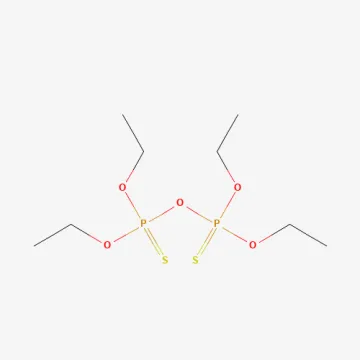
Sulfotep
Description
Mode of action
Sulfotepp belongs to the organophosphorus (OP) chemical class and is a thio-phosphate. This substance acts as a potent inhibitor of the acetylcholinesterase enzyme in the pest organism.
The mechanism of action involves blocking the transmission of nerve impulses in the synapses of insects and mites. As a result, the pest develops uncontrollable convulsions, paralysis, and inevitable death.
The substance is characterized by high volatility, allowing it to be used primarily as a fumigant. The vapors of the preparation penetrate the respiratory system of pests, providing a rapid killing effect.
By its nature, sulfotepp has systemic or semi-systemic action depending on the method of introduction into the habitat. It is capable of affecting pests even in hard-to-reach places due to its gaseous phase.
Unlike many contact insecticides, sulfotepp shows high activity at relatively low temperatures, which makes it effective in greenhouses.
What it targets
Sulfotepp is used in protected soil (greenhouses, orangeries) to control a wide range of sucking pests.
The main targets are spider mites, which often infest ornamental and vegetable crops, causing rapid drying of leaves.
The preparation demonstrates high effectiveness against various species of aphids, whiteflies, and thrips hiding on the underside of leaf blades.
The use of the substance allows for a rapid reduction in the number of pest populations that have reached the economic threshold of damage.
- Spider mites
- Greenhouse whitefly
- Various aphid species
- Thrips
Rates and timing
The application of sulfotepp requires strict adherence to temperature and time regimes, as the preparation evaporates to form a toxic cloud.
Treatments are carried out in the evening or at night when the probability of personnel presence in the greenhouse is minimal and pest activity is higher.
The dosage is calculated based on the volume of the room (cubic meters), as the primary factor is the concentration of vapors in the air.
After fumigation, the room must remain hermetically sealed for 6–12 hours to achieve the maximum effect.
It is crucial to conduct proper ventilation of greenhouses after the exposure time ends to avoid crop damage and personnel intoxication.
Restrictions
Sulfotepp is a highly toxic substance for humans and warm-blooded animals, requiring the use of personal protective equipment for respiratory organs and skin.
It is strictly forbidden to enter the treated area without special equipment until the vapors have completely cleared and air quality control has been performed.
Due to the high phytotoxicity of some crops under certain conditions, preliminary testing on a small group of plants is recommended.
Prolonged use can lead to the development of resistance in some mite species, so the preparation should be alternated with insecticides from other groups.
Storage must be carried out in strictly airtight containers, in rooms with restricted access, and in compliance with fire safety regulations.
Status in the European Union
Not approved in the EU
- CAS number
- 3689-24-5
- Category (EU)
- AC - Acaricide
EU status is for reference only and does not replace national registration in your country.