
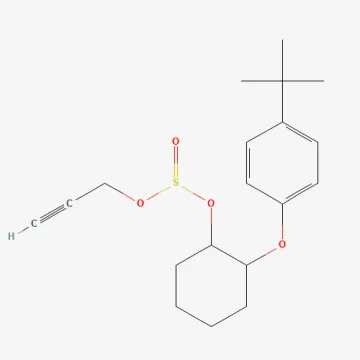
Propargite
Description
Mode of action
Propargite belongs to the sulfite chemical class and functions as a specific contact acaricide. It provides a rapid knockdown effect, effectively stopping mite feeding on plant tissues shortly after application.
The mechanism of action involves the inhibition of mitochondrial oxidative phosphorylation within the mite's organism. This disruption of cellular energy metabolism leads to paralysis and death within a relatively short timeframe.
Propargite is characterized by high lipophilicity, allowing it to adhere well to leaf surfaces and resist wash-off by rain. This property ensures a long residual period of protection, which is crucial for managing mite populations during critical crop growth stages.
Because the substance lacks systemic activity, effective control depends heavily on thorough spray coverage. Growers must ensure that all plant surfaces, particularly the undersides of leaves, are adequately wetted to achieve the desired result.
The compound is highly effective against all mobile stages of mites, including larvae, nymphs, and adults. However, as it has limited ovicidal activity, timing applications correctly is essential to target the next generation of hatchlings.
What it targets
Propargite is widely used for controlling various phytophagous mites belonging to the Tetranychidae and Eriophyidae families.
- Two-spotted spider mite (Tetranychus urticae)
- European red mite (Panonychus ulmi)
- Grape blister mite (Colomerus vitis)
- Cyclamen mite
- Various other mite species affecting horticultural and vegetable crops
This active ingredient is particularly valuable in managing populations that have developed resistance to organophosphates and other common acaricides, making it a staple in resistance management programs.
Its use is most prevalent in intensive fruit orchards and vineyards, where mite infestations can severely impact yields, cause premature leaf drop, and compromise the overall health of long-term perennial crops.
While often used outdoors, propargite can also be applied in greenhouse settings, provided that application protocols are strictly followed to maintain safety and prevent potential phytotoxicity in enclosed environments.
Rates and timing
Application rates vary based on the specific crop, the intensity of the infestation, and local environmental conditions. Proper tank-mix preparation is essential to ensure consistent concentration and biological efficacy.
Pre-harvest intervals (PHI) are generally significant, often ranging from 20 to 45 days. These requirements are established to account for the residual nature of the chemical and ensure that harvested produce remains within safety limits.
Applications should ideally occur during cooler times of the day, such as early morning or late evening. High temperatures (above 25–27°C) can increase the risk of phytotoxicity, particularly on young or tender foliage.
The frequency of application is dictated by the mite's life cycle and local pest pressure. If necessary, follow-up treatments should be scheduled 10–14 days later, ensuring the use of products with different modes of action to prevent resistance buildup.
Water quality and pH levels are critical factors. Alkaline water can cause rapid hydrolysis of the active ingredient, significantly reducing its stability and performance in the field before it even reaches the target.
Restrictions
Propargite requires careful handling. Operators must wear full personal protective equipment (PPE), including gloves, goggles, and respiratory protection, to minimize exposure to the substance during mixing and application.
It is incompatible with alkaline substances, including lime-sulfur or Bordeaux mixture. Mixing propargite with such materials will lead to chemical degradation and a loss of acaricidal efficiency.
Phytotoxicity can occur under stress conditions, such as drought or high humidity, or when applied to plants in sensitive growth stages during hot weather. Growers should perform small-scale tests if applying to new or sensitive cultivars.
The product is toxic to aquatic organisms. It must be kept away from water sources, and buffer zones must be maintained to protect biodiversity and beneficial fauna, including pollinators, in surrounding ecosystems.
Storage should be in a cool, dry, and well-ventilated area, away from direct sunlight, moisture, and food products. The original container must be kept tightly sealed to maintain product integrity until use.
Status in the European Union
Not approved in the EU
- CAS number
- 2312-35-8
- Category (EU)
- AC - Acaricide
- ADI
- 0.03 mg/kg bw/day
- ARfD
- 0.06 mg/kg bw
EU status is for reference only and does not replace national registration in your country.