

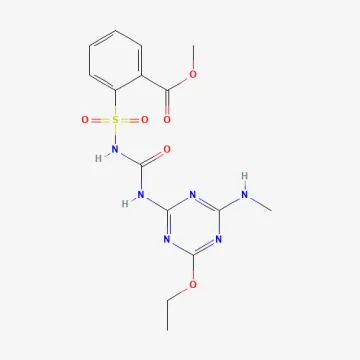
Description
Mode of action
Ethametsulfuron-methyl belongs to the sulfonylurea chemical class. It is a highly effective active ingredient that acts as a systemic selective herbicide.
Its mechanism of action is based on the inhibition of the acetolactate synthase (ALS) enzyme in weeds. This enzyme is essential for the synthesis of branched-chain amino acids, specifically valine, leucine, and isoleucine.
The inhibition of amino acid synthesis leads to a rapid cessation of cell division in the meristematic tissues of weeds. Initial visual symptoms typically appear within 5 to 10 days after application.
Complete control of sensitive weed species usually occurs within two to three weeks. The speed of action depends on environmental temperatures and the physiological state of the plants.
The substance is rapidly absorbed by both leaves and roots of weeds, after which it is translocated through the xylem and phloem to active growth centers.
What it targets
This substance is primarily used for the control of a wide range of broad-leaved weeds, including the most difficult-to-control species in rapeseed crops.
It is effective against weed species that have developed resistance to other herbicide classes, making it a critical tool in integrated weed management strategies.
The spectrum of suppressed weeds includes: Chenopodium album, Polygonum species, Amaranthus, Raphanus raphanistrum, Sinapis arvensis, Capsella bursa-pastoris, and many others.
The efficacy also extends to Thlaspi arvense, Stellaria media, and certain Cirsium species when they are at early developmental stages.
- High efficacy against cruciferous weeds.
- Suppression of volunteer cereals in rapeseed crops.
- Impact on weeds with waxy leaf surfaces.
Rates and timing
The application of ethametsulfuron-methyl requires strict adherence to regulations, as the substance exhibits high biological activity even at low dosage rates.
The optimal timing for application is during the active growth phase of weeds, typically from the cotyledon stage up to the four-leaf stage of the weeds.
Application rates depend on the density of weed infestation and the specific weed composition. Using adjuvants is generally mandatory to improve spray retention and penetration.
It is not recommended to apply the herbicide if the crop is under stress due to drought, frost, or pest damage, as this may reduce crop selectivity.
When planning tank mixes, it is essential to perform a compatibility test, avoiding combinations with certain organophosphate insecticides to prevent potential phytotoxicity.
Restrictions
A major limitation is the potential for soil residual activity on subsequent crops in the rotation, which requires careful planning of agricultural practices.
Spray drift must be strictly avoided, as the active ingredient has high herbicidal activity and can cause severe damage to adjacent sensitive crops.
In prolonged drought conditions, the breakdown of the active substance in the soil can be significantly delayed, increasing the risk of carry-over damage to next-season crops.
Do not apply the product during hot weather when air temperatures exceed 25 degrees Celsius, nor when heavy dew is present on the leaf surfaces.
To prevent the development of weed resistance, it is highly recommended to rotate the use of ethametsulfuron-methyl with herbicides from different chemical groups.
Regulatory
Status in the European Union
Not approved in the EU
- CAS number
- 97780-06-8
- Category (EU)
- HB - Herbicide
EU legislation
EU status is for reference only and does not replace national registration in your country.
Content graph
Connections · Ethametsulfuron-methyl
Most often together:
Marketplace
Products · 9


